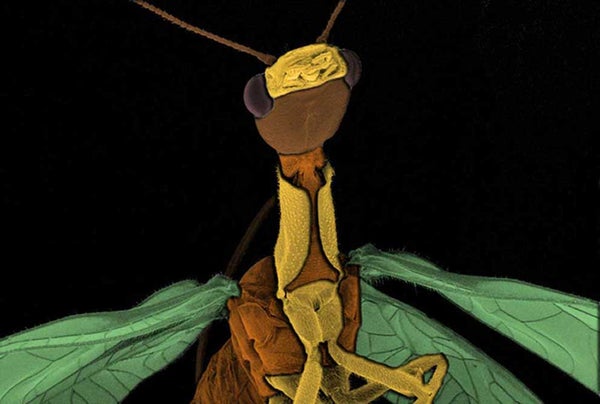
Agulla ("Stretch") the snakefly, might not win any beauty contests, but as predicted last month in ScientificAmerican.com 's 60-Second Science podcast , its serpentine head and superlong neck helped it take home first prize in this year's Arizona State University's (A.S.U.) annual Ugly Bug Contest .
MARILEE SELLERS/THERRY THE/NORTHERN ARIZONA UNIVERSITY/PAGE BALUCH/ARIZONA STATE UNIVERSITY
Join Our Community of Science Lovers!
On supporting science journalism
If you're enjoying this article, consider supporting our award-winning journalism by subscribing. By purchasing a subscription you are helping to ensure the future of impactful stories about the discoveries and ideas shaping our world today.
Agulla ("Stretch") the snakefly, might not win any beauty contests, but as predicted last month in ScientificAmerican.com's 60-Second Science podcast, its serpentine head and superlong neck helped it take home first prize in this year's Arizona State University's (A.S.U.) annual Ugly Bug Contest.
Weighing in at just four milligrams (and measuring about 15 millimeters long), this champion creepy-crawly corralled a triumphant 31 percent of the contest's 8,023 votes, easily edging out the second-place (and hardly beloved) Periplaneta americana ("La Cucaracha") American cockroach as well as third's Macrosiphon ("The Blade") aphid.
When they're not busy being photographed under microscopes by biologists, snakeflies are predatory insects that feast on aphids, caterpillars and beetles, and have been buzzing around since at least the Cretaceous period.
Compiled by A.S.U.'s "Ask A Biologist" initiative along with Northern Arizona University, the contest has been extolling ugly bugs since 1997, awarding its highest honor in 2008 to the tick.
In a similar contest from the Oklahoma Microscopy Society earlier this year, the praying mantis, sphinx moth, red leg tip centipede and robber fly—all collected by local elementary schools—won out as bugs with the ugliest mugs from a pool of 80 nasty nominees.
The least repulsive insect? This year, last place in A.S.U.'s contest went to fuzzy Apis "Sweetness" honeybee.
Subscribe to Support Independent Journalism
Great science journalism requires human expertise, time, effort and creativity. And it costs money. That’s why I and the journalists here at Scientific American hope you’ll join our community.
When you subscribe, you are supporting staff and freelance journalists who are passionate about telling science stories that are true, important and compelling. Our editors and reporters are often experts in their fields, which means they understand the nuances of big discoveries and can untangle the breakthroughs from the hype. With a subscription, you are also supporting rigorous fact-checking to ensure the words we publish are precise and accurate. And you’re supporting original illustrations, graphics and photos that bring you closer to an advanced laboratory, an ice sheet in Antarctica or a space mission in orbit. You’re helping us craft other types of high-quality journalism as well: Our newsletters are carefully written, edited and curated by staffers you have or will come to know and love. Our Science Quickly podcast is based on original reporting, collaboration with editors and scientists and exacting production.
Subscriptions keep this engine running so we can continue to deliver thoughtful, rigorous and independent science journalism to you. In an era of viral misinformation, this work is crucial. If you value what we do, I hope you’ll consider joining us as a subscriber
Thank you,
Jeanna Bryner, Editor in Chief, Scientific American