
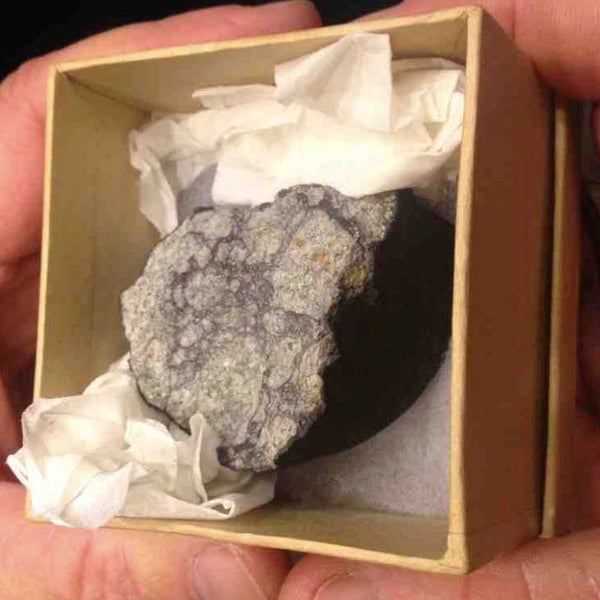
The Chelyabinsk meteor entered the atmosphere over Russia on February 15, 2013. It exploded with a half a megaton of energy, generating a shock wave that blew down walls and injured over 1,000 people. The meteor ended up largely destroyed in the airburst. Samples of the meteorite, however, survived, such as the one pictured above. "You can think of it as Christmas in meteor-astronomy land," physicist Mark Boslough said in a press conference at the American Geophysical Union meeting on December 9, directly quoting his colleague physicist Peter Brown. The event provides data to answer long-standing questions about solar system processes in the last 4.5 billion years.
Scientists immediately deduced that the small asteroid had previously collided with other objects prior to making its way to Earth. The previous impact events weakened the meteorite, making it more susceptible to blowing up as an air burst. “Had the object been a little bit larger, and a little bit stronger, it may have pierced the entire atmosphere and produced an impact crater at the surface,” says physicist Davis A. Kring, the senior staff scientist at the Universities Space Research Association’s Lunar and Planetary Institute in Houston.
Within the meteorite (the whiter portion of the rock) are round grains called chondrules, which were once molten droplets in the solar nebula, before the planets formed. As the solar system coalesced, dust melted to form those droplets, which then solidified to become chondrules. By studying the different marks in the meteorite, researchers concluded that two or three different impact events had taken place prior to the one in February, the first occurring 4.42 billion years ago. Rock samples related to the Chelyabinsk meteorite showed the parent asteroid was bombarded by a lot of other impact events from about 4.3 to 3.8 billion years ago, followed by a period of quiet in collisional activity, and then an increase in collisions again about two billion years ago.
On supporting science journalism
If you're enjoying this article, consider supporting our award-winning journalism by subscribing. By purchasing a subscription you are helping to ensure the future of impactful stories about the discoveries and ideas shaping our world today.
A collision the size of the Chelyabinsk occurs on average every 10 to 100 years, Kring says. “A mass extinction size impact even occurs on average once per 100 million years.” That doesn’t mean, however, that we should wait tens of million years to figure out how to handle the event. “We don’t just ignore rare diseases,” Kring said in the conference. “We try to find a cure. We should do the same thing with rare events” like asteroid impacts.
—Julianne Chiaet