
On supporting science journalism
If you're enjoying this article, consider supporting our award-winning journalism by subscribing. By purchasing a subscription you are helping to ensure the future of impactful stories about the discoveries and ideas shaping our world today.
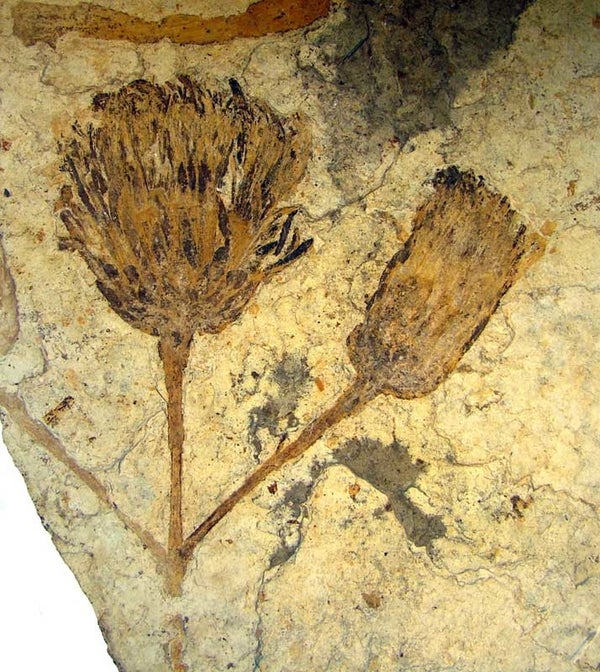
Talk about old pressed flowers, this extinct sunflower relative was collected—compliments of the fossil record—about 47.5 million years ago.
The specimen is a rare and detailed peek into the prolific flower family (known as Asteraceae, or Compositae) that has given rise to some 23,000 modern species, including chrysanthemums, daisies and sunflowers—as well as artichokes and lettuce. It is described in a study published online September 23 in Science.
Found along the Río Pichileufú, in the northwestern part of Argentina's Patagonia region, the plant is an unusual find for the time period. Because large, well-preserved full-flower fossils are rarely unearthed, researchers have often had to rely on ancient pollen samples to make estimates about floral phylogenic relationships. "The Palaeogene [period] record of Asteraceae is so sparse that the discovery of one new fossil can have a substantial effect on known time ranges in the phylogenic tree," noted the authors of the new study, led by Viviana Barreda of the at the Argentina Museum of Natural Science in Buenos Aires.
The researchers propose that the line that lead to sunflowers had already split before this flower sprouted, which is much earlier than hypotheses based on molecular analysis had asserted. The find also suggests a warm and relatively humid climate, with average temperatures of around 19 degrees Celsius.
"At long last, there is clear macrofossil evidence of the sunflower family at an early stage of its diversification," Tod Stuessy, of the University of Vienna, wrote in an essay published in the same issue of Science. What's more, he noted, the fossil was found "just where it had been hypothesized to originate."