
On supporting science journalism
If you're enjoying this article, consider supporting our award-winning journalism by subscribing. By purchasing a subscription you are helping to ensure the future of impactful stories about the discoveries and ideas shaping our world today.
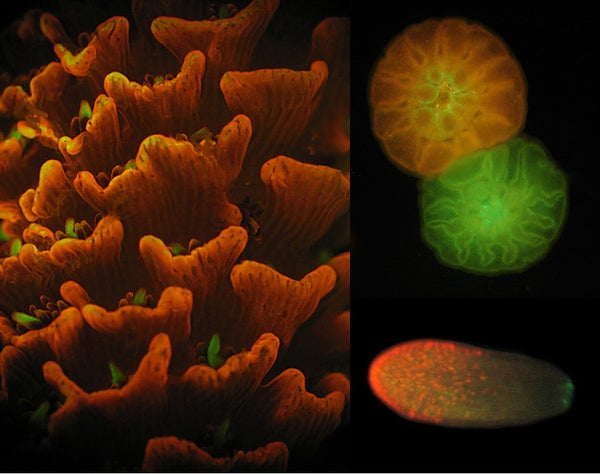
Coral reefs are home to a stunning array of sea life. Turn on a black light and these watery housing complexes go from shabby chic to day-glo fab. Tiny coral polyps [top right], whose accumulated skeletons make up the massive reefs, contain proteins that fluoresce in a multitude of colors. The biological role of coral fluorescence remains largely a mystery, and proposed explanations range from sensory functions to help-wanted advertisements for symbiotic algae.
Coral larvae [bottom right], the free-floating offspring of adult coral, also fluoresce. A new study, published online January 26 in Proceedings of Royal Society B: Biological Sciences, finds that the color coral larvae emanate may indicate where they will settle and form new colonies.
Researchers crossed parental coral [left]of different fluorescent phenotypes and harvested coral larvae in various shades of red and green. Larvae were sorted into large petri dishes based on color and tempted with a natural settlement cue: ground-up crustose coralline algae. The redder larvae "prefer to stay swimming when presented with the cue, while greens happily settle and metamorphose into polyps," co-author Mikhail Matz of The University of Texas at Austin says. Overall, larval color accounted for 56.2 percent of the settlement variation, with other factors including inherited parental traits and stress from heat and light.
The researchers suggest that larval color could be used to investigate the genetic underpinning of settlement propensity. Larvae that are reluctant to settle may be more likely to start colonies distant from their parental colonies—and such wanderlust could help endangered coral cope with the effects of global warming. (Note: images are not to scale.)
–Nina Bai