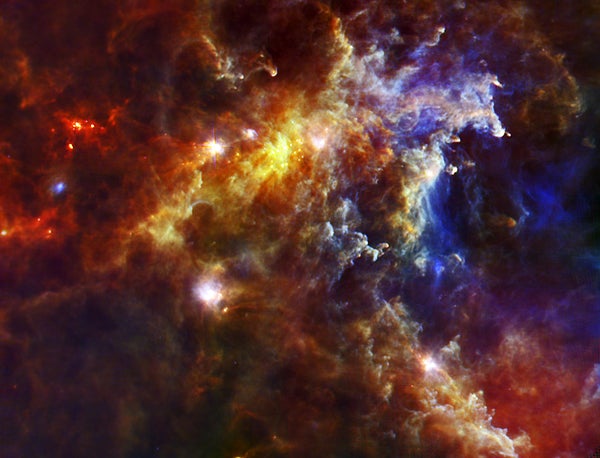
Herschel space observatory peers into stellar nursery
Protostars shine in their dusty shrouds in this image of the molecular cloud associated with the Rosette Nebula from the European Space Agency's Herschel spacecraft .
If you're enjoying this article, consider supporting our award-winning journalism by subscribing. By purchasing a subscription you are helping to ensure the future of impactful stories about the discoveries and ideas shaping our world today.
Herschel, built in conjunction with NASA and launched last year, boasts the largest telescope mirror ever launched into space, 3.5 meters in diameter. Like NASA's James Webb Space Telescope, set to be launched in 2014 with an even larger 6.5-meter mirror, Herschel collects infrared light. Visibility in that range of the electromagnetic spectrum, which is greatly reduced on Earth due to atmospheric absorption, allows the observatory to peer at stars being created inside dusty molecular clouds. At the time of its launch, Paul Goldsmith, Herschel project scientist at the NASA Jet Propulsion Laboratory in Pasadena, Calif., told ScientificAmerican.com that Herschel's infrared view of star birth would be "analogous to using ultrasound to seeing what is going on in a mother's womb."
In the image above, Herschel reveals star formation in a region of the Milky Way's Rosette Nebula. About 4,500 light-years away in the direction of the constellation Monoceros, the nebula is large enough to be visible through small telescopes; if it were bright enough in the visible spectrum it could be seen by the naked eye, occupying several times as much of the sky as the full moon.
Subscribe to Support Independent Journalism
Great science journalism requires human expertise, time, effort and creativity. And it costs money. That’s why I and the journalists here at Scientific American hope you’ll join our community.
When you subscribe, you are supporting staff and freelance journalists who are passionate about telling science stories that are true, important and compelling. Our editors and reporters are often experts in their fields, which means they understand the nuances of big discoveries and can untangle the breakthroughs from the hype. With a subscription, you are also supporting rigorous fact-checking to ensure the words we publish are precise and accurate. And you’re supporting original illustrations, graphics and photos that bring you closer to an advanced laboratory, an ice sheet in Antarctica or a space mission in orbit. You’re helping us craft other types of high-quality journalism as well: Our newsletters are carefully written, edited and curated by staffers you have or will come to know and love. Our Science Quickly podcast is based on original reporting, collaboration with editors and scientists and exacting production.
Subscriptions keep this engine running so we can continue to deliver thoughtful, rigorous and independent science journalism to you. In an era of viral misinformation, this work is crucial. If you value what we do, I hope you’ll consider joining us as a subscriber
Thank you,
Jeanna Bryner, Editor in Chief, Scientific American