
On supporting science journalism
If you're enjoying this article, consider supporting our award-winning journalism by subscribing. By purchasing a subscription you are helping to ensure the future of impactful stories about the discoveries and ideas shaping our world today.
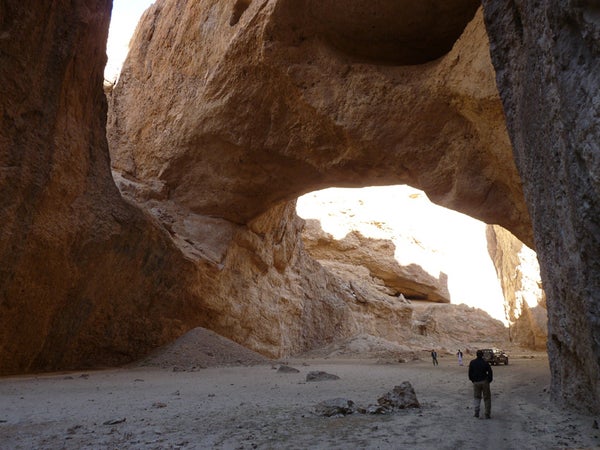
One of the world's largest natural stone arches has been discovered in the central highlands of Afghanistan. Wildlife Conservation Society staff were tracking the area for wildlife when they chanced on this natural bridge in late 2010. They measured it in February and found that it's 64 meters wide and more than 18 meters tall.
It now ranks as the 12th largest natural bridge in the world, usurping Outlaw Arch in Utah's Dinosaur Natural Monument. Researchers named the feature Hazarchishma Natural Bridge after a nearby village.
The arch includes rock from the Jurassic period, 200 million to 145 million years ago, and the Eocene epoch, 55 million to 34 million years ago. Ancient water running through the now dry Jawzari Canyon carved out the underside of the bridge.
The discovery is part of a trend among local and foreign scientists to focus again on Afghanistan after decades of civil war and invasions there, says Stephen Peters, lead researcher on a U.S. Geological Survey effort to assess the mineral resources in the central Asian country.
More natural wonders could be uncovered by researchers visiting in Afghanistan's difficult-to-reach mountainous regions—part of the Himalaya range runs through the country. The central and eastern highlands are the least explored, Peters says. Both areas are only sparsely populated, mainly by non-Pashtun minorities.
The Afghanistan government has worked recently to preserve its little-seen natural wonders and wildlife. In 2009 officials announced the country's first national park, Band-e-Amir, and an endangered species list.
—Francie Diep