
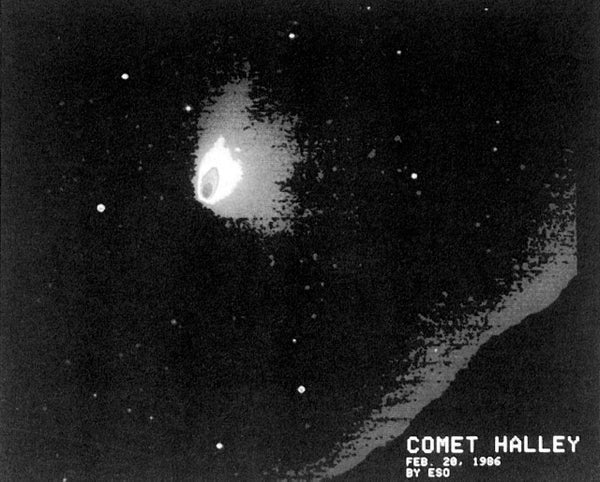
You don’t have to be an astronomer to be familiar with Halley’s Comet. The glowing ball of ice and dust, shown here, passes Earth about every 76 years. English astronomer Edmond Halley first predicted the comet’s recurring orbit in 1705. Halley identified a pattern of comets that had approached Earth in 1531, 1607 and 1682, and predicted it would return again in 1758. Although he died before he could witness what would become his namesake comet’s return, from its periodicity he concluded that it would orbit the sun on a regular basis.
Halley’s has become famous because “it’s the only short-period comet that a human can count on seeing in his lifetime,” says Bill Cooke, lead at NASA’s Meteoroid Environment Office. His comet last passed Earth in 1986, and it was about as bright as Polaris, aka the North Star. Astronomers measure the brightness of objects in the sky on a scale of apparent magnitude—the brighter the object, the greater the negative number; the dimmer, the greater the positive number. The sun is very bright and registers –26 magnitude, compared with the full moon, which is about –13 magnitude to the naked eye. The 1986 visit by Halley’s was 2 magnitude. Halley’s next pass should be in July 2061, at an expected brightness of about –0.3. “It’s not going to be a fairly spectacular apparition,” Cooke says.
But don’t worry about missing out, Cooke says. There’s a chance of a newly discovered comet showing up. “That’s kind of one of the nice and bad things about comets; most of the really bright ones are first timers that come in out of the Oort Cloud”—a giant cloud of icy debris that surrounds the solar system—“and you can’t predict those, they just show up,” he says. An example is Comet Hale-Bopp. As it passed Earth in 1997 it became bright enough to see with the naked eye, shining at around –1 magnitude.
On supporting science journalism
If you're enjoying this article, consider supporting our award-winning journalism by subscribing. By purchasing a subscription you are helping to ensure the future of impactful stories about the discoveries and ideas shaping our world today.
Stargazers may remember other naked-eye comets such as West in 1976, which fragmented into the sun, and the long-tailed Hyakutake a year earlier. Whereas those were easy to spot, Cooke suggests pairing a telescope with a charge-coupled device camera for best views of future comets (although he did say that binoculars will suffice for brighter ones). Cooke says that astronomers will give the rest of us plenty of time to get ready. The icy space travelers “are pretty hard to miss,” he says. “We’ve gotten pretty good at discovering comets.”
- Kevin Schultz