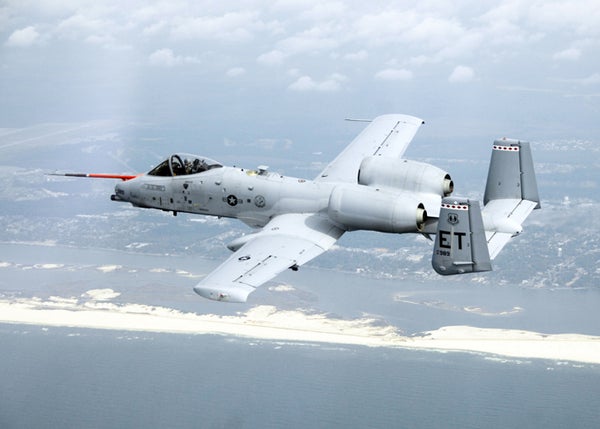
The U.S. Air Force burns through 2.4 billion gallons of jet fuel a year, all of it derived from oil.
U.S. Air Force photo/Senior Master Sgt. Joy Josephson
Join Our Community of Science Lovers!
On supporting science journalism
If you're enjoying this article, consider supporting our award-winning journalism by subscribing. By purchasing a subscription you are helping to ensure the future of impactful stories about the discoveries and ideas shaping our world today.
The U.S. Air Force burns through 2.4 billion gallons of jet fuel a year, all of it derived from oil. But a test flight on March 25 just might allow a flowering weed known as camelina to replace petroleum as part of the military's energy mix. An A-10C Thunderbolt II aircraft took flight from Elgin Air Force Base in Florida using solely a synthetic jet fuel refined from camelina oil.
Further jet biofuel flights in an F-15, C-17 and F-22 are planned for later this year. The Air Force hopes to derive as much as half of its fuel requirements from alternative sources, such as camelina, by 2016—and certify all its aircraft to fly on such alternative fuels by 2012. "This sortie was pretty uneventful and predictable," said test pilot Maj. Chris Seager after the flight, according to an Air Force press release. Yet, it just might help the Air Force get a little greener.
It’s Time to Stand Up for Science
If you enjoyed this article, I’d like to ask for your support. Scientific American has served as an advocate for science and industry for 180 years, and right now may be the most critical moment in that two-century history.
SciAm always educates and delights me, and inspires a sense of awe for our vast, beautiful universe. I hope it does that for you, too.
If you subscribe to Scientific American, you help ensure that our coverage is centered on meaningful research and discovery; that we have the resources to report on the decisions that threaten labs across the U.S.; and that we support both budding and working scientists at a time when the value of science itself too often goes unrecognized.