Raging Polar Storm on Saturn Caught by Cassini Spacecraft
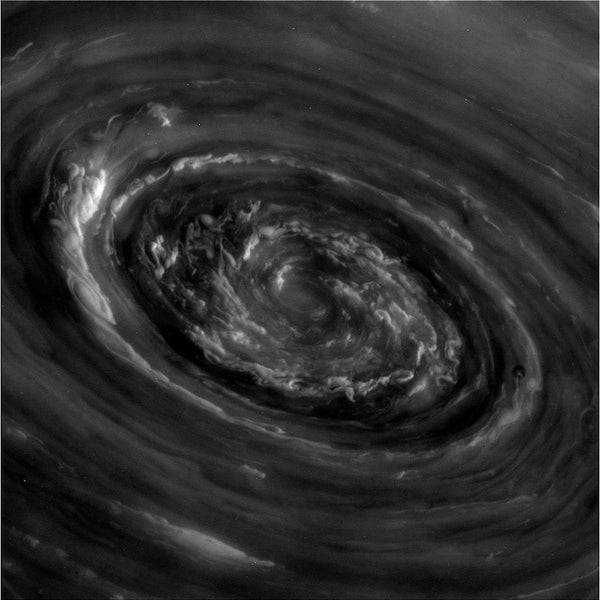
Conditions near Earth’s poles can be pretty harsh , but the storms over Saturn’s polar regions blow them away.
NASA/JPL/Space Science Institute
Join Our Community of Science Lovers!
Conditions near Earth’s poles can be pretty harsh, but the storms over Saturn’s polar regions blow them away.
NASA’s Cassini spacecraft photographed storm-twisted Saturnian clouds, spun into tufts that resemble loose wool or strands of cotton candy, as the orbiter passed above the giant planet’s northern polar region. The spacecraft acquired the raw, unprocessed image on November 27 from a distance of about 365,000 kilometers—roughly equivalent to the separation between Earth and the moon. Previous surveys by Cassini have found that winds whip through the atmosphere over Saturn’s north pole at more than 500 kilometers per hour—30 percent faster than any gust ever recorded in a cyclone on Earth.
The spiraling vortex pictured here sits within an even more dramatic feature—a giant hexagonal cloud structure, some 25,000 kilometers across, that has persisted for decades over the north pole. The curious polar hexagon was discovered in the 1980s during flybys of Saturn by the twin Voyager spacecraft.
On supporting science journalism
If you're enjoying this article, consider supporting our award-winning journalism by subscribing. By purchasing a subscription you are helping to ensure the future of impactful stories about the discoveries and ideas shaping our world today.
—John Matson
Subscribe to Support Independent Journalism
Great science journalism requires human expertise, time, effort and creativity. And it costs money. That’s why I and the journalists here at Scientific American hope you’ll join our community.
When you subscribe, you are supporting staff and freelance journalists who are passionate about telling science stories that are true, important and compelling. Our editors and reporters are often experts in their fields, which means they understand the nuances of big discoveries and can untangle the breakthroughs from the hype. With a subscription, you are also supporting rigorous fact-checking to ensure the words we publish are precise and accurate. And you’re supporting original illustrations, graphics and photos that bring you closer to an advanced laboratory, an ice sheet in Antarctica or a space mission in orbit. You’re helping us craft other types of high-quality journalism as well: Our newsletters are carefully written, edited and curated by staffers you have or will come to know and love. Our Science Quickly podcast is based on original reporting, collaboration with editors and scientists and exacting production.
Subscriptions keep this engine running so we can continue to deliver thoughtful, rigorous and independent science journalism to you. In an era of viral misinformation, this work is crucial. If you value what we do, I hope you’ll consider joining us as a subscriber
Thank you,
Jeanna Bryner, Editor in Chief, Scientific American