August 20, 2008
1 min read
 Add Us On GoogleAdd SciAm
Rivers of Stars Found in Milky Way
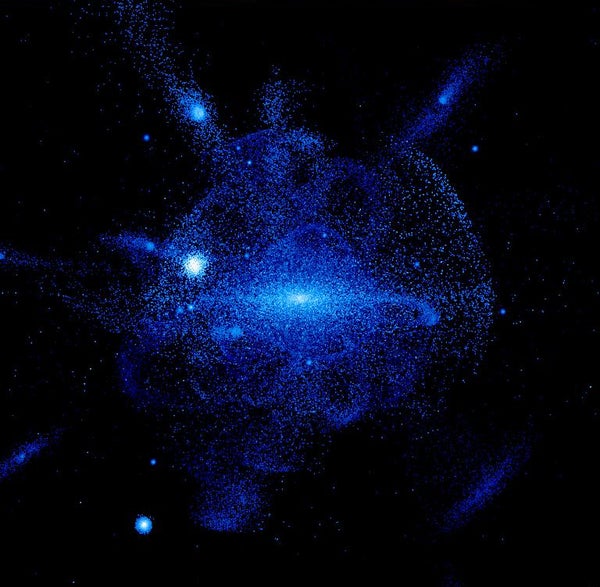
Astronomers have discovered nearly a dozen new stellar rivers —strings of moving stars—over the disk of the Milky Way.
On supporting science journalism
If you're enjoying this article, consider supporting our award-winning journalism by subscribing. By purchasing a subscription you are helping to ensure the future of impactful stories about the discoveries and ideas shaping our world today.
Astronomers have discovered nearly a dozen new stellar rivers—strings of moving stars—over the disk of the Milky Way. The streams, which seem to represent smaller galaxies torn apart by our own, come from scans of the velocities of about a quarter million stars in our galaxy made for the Sloan Digital Sky Survey. Prior scans had turned up a few narrow rivers such as one extending from the star cluster NGC 5466, 76,000 light-years away, that covers 45 degrees across the northern sky. The 11 new entries form a tangle that's harder to separate. Researchers believe that the streams arose separately when neighboring star clusters known as dwarf galaxies were drawn apart like taffy by the Milky Way's larger gravitational field. They say the new findings, reported at a conference this week, could be used to improve models of galaxies colliding with and cannibalizing one another.
Subscribe to Support Independent Journalism
Great science journalism requires human expertise, time, effort and creativity. And it costs money. That’s why I and the journalists here at Scientific American hope you’ll join our community.
When you subscribe, you are supporting staff and freelance journalists who are passionate about telling science stories that are true, important and compelling. Our editors and reporters are often experts in their fields, which means they understand the nuances of big discoveries and can untangle the breakthroughs from the hype. With a subscription, you are also supporting rigorous fact-checking to ensure the words we publish are precise and accurate. And you’re supporting original illustrations, graphics and photos that bring you closer to an advanced laboratory, an ice sheet in Antarctica or a space mission in orbit. You’re helping us craft other types of high-quality journalism as well: Our newsletters are carefully written, edited and curated by staffers you have or will come to know and love. Our Science Quickly podcast is based on original reporting, collaboration with editors and scientists and exacting production.
Subscriptions keep this engine running so we can continue to deliver thoughtful, rigorous and independent science journalism to you. In an era of viral misinformation, this work is crucial. If you value what we do, I hope you’ll consider joining us as a subscriber