New Issue: Orbital Catastrophe Ahead? Read Now

See a Male Seahorse Give Birth

Unlike almost all other animal species, it is male seahorses who become pregnant and birth young

Korean seahorse

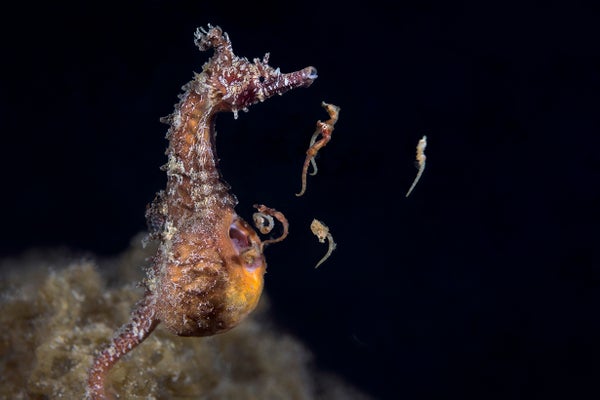
Korean seahorse (Hippocampus haema) releases young into the water off the coast of Japan.

Join Our Community of Science Lovers!


On supporting science journalism

If you're enjoying this article, consider supporting our award-winning journalism by subscribing. By purchasing a subscription you are helping to ensure the future of impactful stories about the discoveries and ideas shaping our world today.


In all of the vast animal kingdom spanning the planet, seahorses (and their pipefish and sea dragon relatives) are the only species whose male members give birth to young. This underwater photograph shows a male Korean seahorse (Hippocampus haema) releasing juveniles into the water off the coast of Japan. The tiny species, which was only recognized in 2017, generally grows to between about five and nine centimeters long and is native to the Korea Strait and the seas to the east of the Korean peninsula and to the south and west of Japan. After an elaborate courtship “dance,” females deposit their eggs into a male’s brood pouch, where he fertilizes them. As the embryos grow, the male’s abdomen becomes distended, just as in a human pregnancy. When he is ready to give birth, the abdomen opens, and contractions expel the juvenile seahorses. Some newborns resemble miniature versions of adults, while others may still be curled up and covered by some of their egg membrane. A male and female seahorse pair can have multiple broods. It is unknown why seahorses have this sex reversal when it comes to procreation, but one idea is that having the male bear young leaves the female free to start producing the next batch of eggs.

Science in Images is a new category of articles featuring photographs and videos from all the disciplines of science. Click on the button below to see the full collection.

Science in Images

Andrea Thompson is senior editor for Earth and environment at Scientific American, covering the environment, energy and Earth sciences. She has been covering these topics for nearly two decades. Prior to joining Scientific American, she was a senior writer covering climate science at Climate Central and a reporter and editor at Live Science, where she primarily covered earth science and the environment. She has moderated panels, including as part of the United Nations Sustainable Development Media Zone, and appeared in radio and television interviews on major networks. She holds a graduate degree in science, health and environmental reporting from New York University, as well as a B.S. and an M.S. in atmospheric chemistry from the Georgia Institute of Technology. Follow Thompson on Bluesky @andreatweather.bsky.social

More by Andrea Thompson

Subscribe to Support Independent Journalism

Great science journalism requires human expertise, time, effort and creativity. And it costs money. That’s why I and the journalists here at Scientific American hope you’ll join our community.

When you subscribe, you are supporting staff and freelance journalists who are passionate about telling science stories that are true, important and compelling. Our editors and reporters are often experts in their fields, which means they understand the nuances of big discoveries and can untangle the breakthroughs from the hype. With a subscription, you are also supporting rigorous fact-checking to ensure the words we publish are precise and accurate. And you’re supporting original illustrations, graphics and photos that bring you closer to an advanced laboratory, an ice sheet in Antarctica or a space mission in orbit. You’re helping us craft other types of high-quality journalism as well: Our newsletters are carefully written, edited and curated by staffers you have or will come to know and love. Our Science Quickly podcast is based on original reporting, collaboration with editors and scientists and exacting production.

Subscriptions keep this engine running so we can continue to deliver thoughtful, rigorous and independent science journalism to you. In an era of viral misinformation, this work is crucial. If you value what we do, I hope you’ll consider joining us as a subscriber

Thank you,

Jeanna Bryner, Editor in Chief, Scientific American

Subscribe