If you're enjoying this article, consider supporting our award-winning journalism by subscribing. By purchasing a subscription you are helping to ensure the future of impactful stories about the discoveries and ideas shaping our world today.
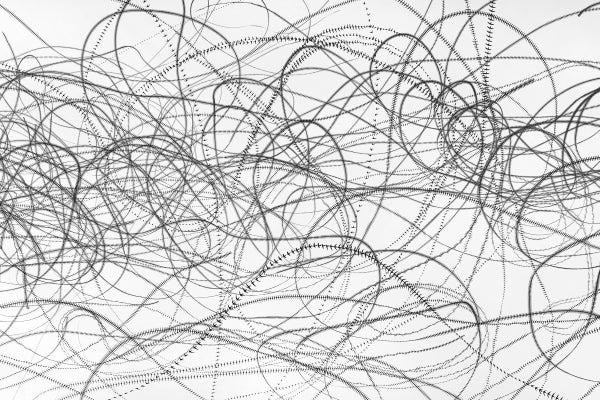
What look like tangled lines of abstract art are actually the result of time-lapse photography of the dizzying flight patterns of the common swift (Apus apus) taken in Barcelona, Spain, in June 2019. “Every morning and afternoon they join in groups to fly in circles or chase each other. They have many different flight behaviors; that's why it’s one of my favorites birds to work with,” says photographer Xavi Bou, who took the shot as part of a long-term project called Ornithographies. The aim of the project is to make these otherwise invisible flight paths visible to humans. From their breeding grounds across Europe and Asia to their wintering grounds in Southern Africa, the dark brown birds capture food and material for their nests while airborne. In fact, a 2016 study in Current Biology that attached small sensors that measured movement to several swifts in Sweden showed that they stayed aloft for 99 percent of their 10-month nonbreeding season. The finding raises the possibility that common swifts sleep while airborne, as some other bird species have been shown to do. Swifts can also live up to their name: a 2010 study in the Journal of Avian Biologyclocked one bird flying at 69.3 mph, the fastest on record for any bird during level flight. The species seems to turn on its turbo drive during “screaming parties,” a social display where they swoop and circle and make high-pitched calls to each other.
Great science journalism requires human expertise, time, effort and creativity. And it costs money. That’s why I and the journalists here at Scientific American hope you’ll join our community.
When you subscribe, you are supporting staff and freelance journalists who are passionate about telling science stories that are true, important and compelling. Our editors and reporters are often experts in their fields, which means they understand the nuances of big discoveries and can untangle the breakthroughs from the hype. With a subscription, you are also supporting rigorous fact-checking to ensure the words we publish are precise and accurate. And you’re supporting original illustrations, graphics and photos that bring you closer to an advanced laboratory, an ice sheet in Antarctica or a space mission in orbit. You’re helping us craft other types of high-quality journalism as well: Our newsletters are carefully written, edited and curated by staffers you have or will come to know and love. Our Science Quickly podcast is based on original reporting, collaboration with editors and scientists and exacting production.
Subscriptions keep this engine running so we can continue to deliver thoughtful, rigorous and independent science journalism to you. In an era of viral misinformation, this work is crucial. If you value what we do, I hope you’ll consider joining us as a subscriber
Thank you,
Jeanna Bryner, Editor in Chief, Scientific American