
On supporting science journalism
If you're enjoying this article, consider supporting our award-winning journalism by subscribing. By purchasing a subscription you are helping to ensure the future of impactful stories about the discoveries and ideas shaping our world today.
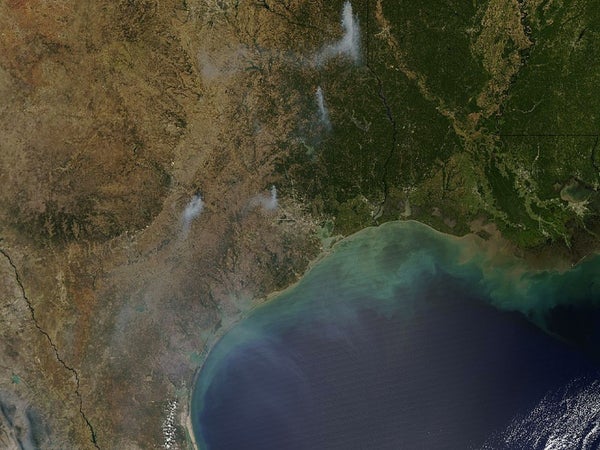
Texas, which has suffered extreme droughts in 2011, is now grappling with deadly, widespread wildfires. Two people were killed September 4 in a fire in Gladewater, Texas, and officials said September 6 that two more had died in the massive Bastrop County fire near Austin. More than 1,000 homes have been destroyed in the past several days, according to the Texas Forest Service (TFS), and dozens of fires continue to burn across the Lone Star State.
NASA's Earth-orbiting Aqua satellite captured this photograph of eastern Texas, Louisiana and the Gulf of Mexico on September 6. (State borders have been overlaid for reference.) In the past week the TFS has responded to 172 fires on 54,653 hectares; more than 1.4 million hectares—2 percent of the state's land area—have burned this year.
The first half of the year was the driest on record in Texas. In June the U.S. Department of Agriculture designated 213 Texas counties as natural disaster areas; nearly all of the state is currently classified as drought level D4 (exceptional drought), the highest such listing on the National Drought Mitigation Center's U.S. Drought Monitor. But the droughts and fires of 2011 may only be a preview of things to come; climate change is expected to raise temperatures and could also reduce rainfall in Texas, according to climate models.