
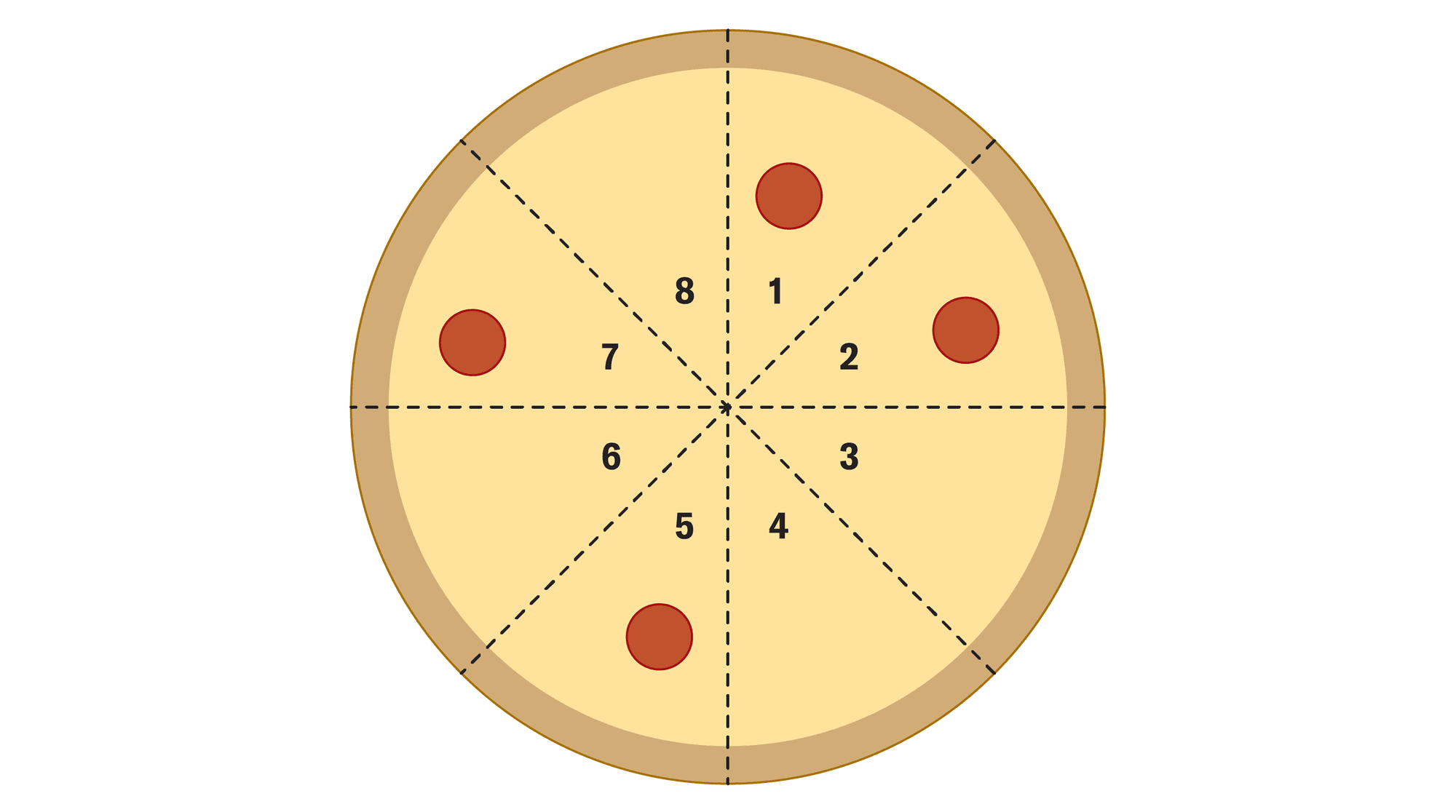
You’re making a pepperoni pizza. You’ve tossed a few pieces of pepperoni onto the pie as shown below when a child enters the kitchen and wants to help. Starting from the pictured arrangement of toppings, every time you place a new piece of pepperoni, the child places a second one on an adjacent slice of their choosing. You continue this way, with you picking a slice to place a pepperoni piece on, followed immediately by the child placing a piece on a neighboring slice. The child says, “Let’s finish when all of the pizza slices have an equal number of pepperoni pieces.” Can you and the child make this happen?

Amanda Montañez
Starting from this arrangement of toppings, the slices will never all contain an equal number of pepperoni pieces.
For every pepperoni piece you place, the child places one, so we can envision the process as placing two pieces at a time on neighboring slices. Number the slices sequentially from one to eight:
Amanda Montanez
Notice that two adjacent slices always consist of one odd number and one even number. So when you place two pepperoni pieces on adjacent slices, the total number of pieces on both odd- and even-numbered slices increases by one. Your pizza’s starting arrangement has three pepperoni pieces on odd-numbered slices and only one piece on an even-numbered slice. You can never correct this imbalance by incrementing the number of pieces on odd and even slices by the same amount.
We’d love to hear from you! E-mail us at games@sciam.com to share your experience.