
If you suspend a Rubik’s Cube near the corner of a room and shine lights at its exposed faces, it will cast square shadows on two walls and the floor.
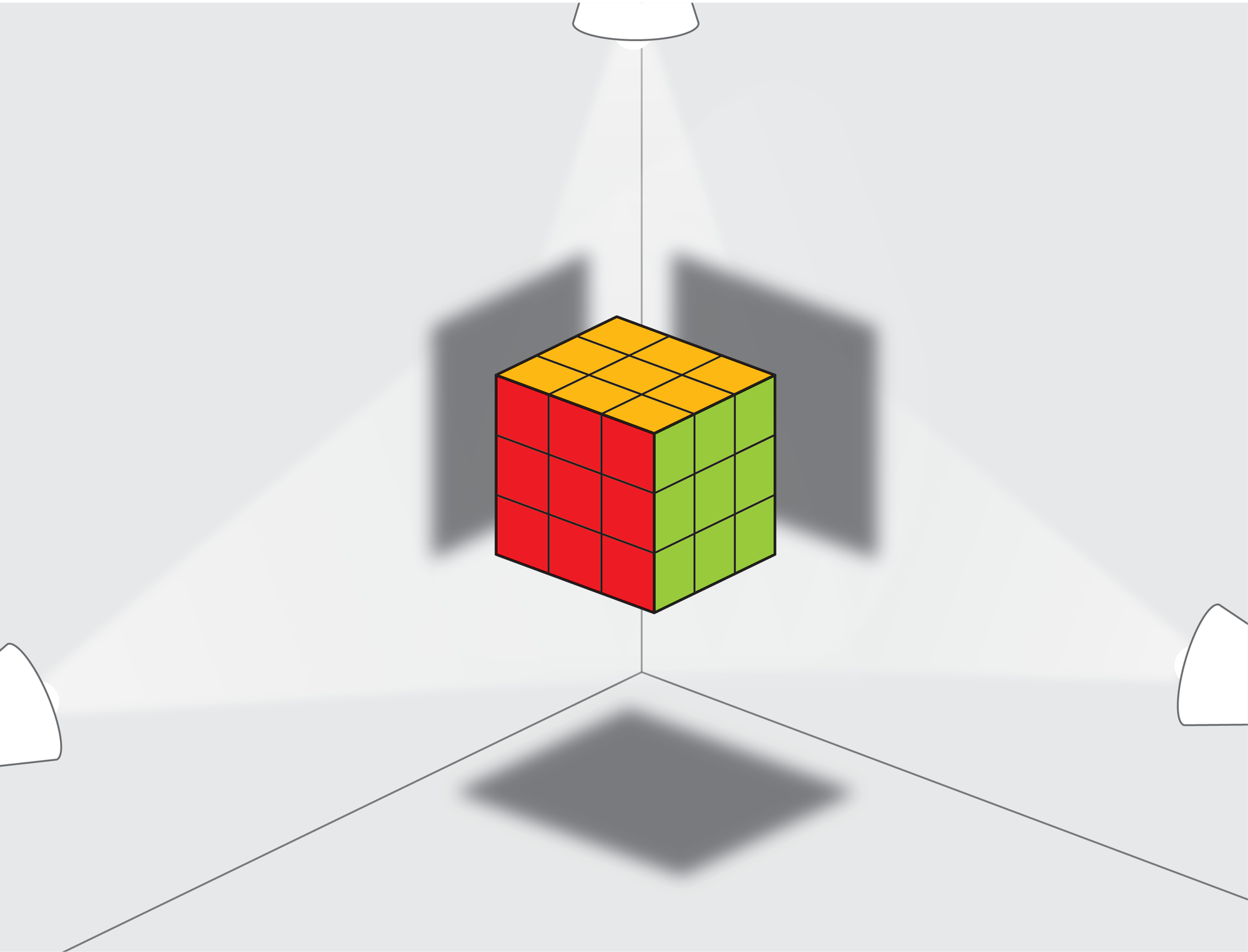
A real-world Rubik’s Cube has a gadget at its core to facilitate rotation, but let’s imagine a simpler picture where it comprises 27 identical “cubelets”: three layers of nine cubelets each.

Notice that if we remove any single cubelet, the shadows won’t change. But if we remove the whole top layer of nine cubelets, the two wall shadows will become 2×3 rectangles. What is the maximum number of cubelets you can remove so that the three shadows remain unchanged? (Ignore the effects of gravity and assume cubelets stay suspended where they are).
Try to shrink the problem in some way. Solve it for a 2×2×2 cube comprised of eight cubelets or approach the 3×3×3 case one layer at a time.
You can remove 18 cubelets while leaving the shadows intact. Surprisingly, you only need nine carefully placed cubelets to cast all three shadows.

Each layer of the Rubik’s Cube contains three rows and three columns comprised of three cubelets each. We’ll call a stack of cubelets in the up-down dimension a pillar. The only way for a shadow to change is for an entire row, column or pillar to go empty. This would let light shine through the cube and poke a hole in one of the shadows. So the question becomes: What is the minimum number of cubelets required so that every row, column and pillar contains at least one cubelet?
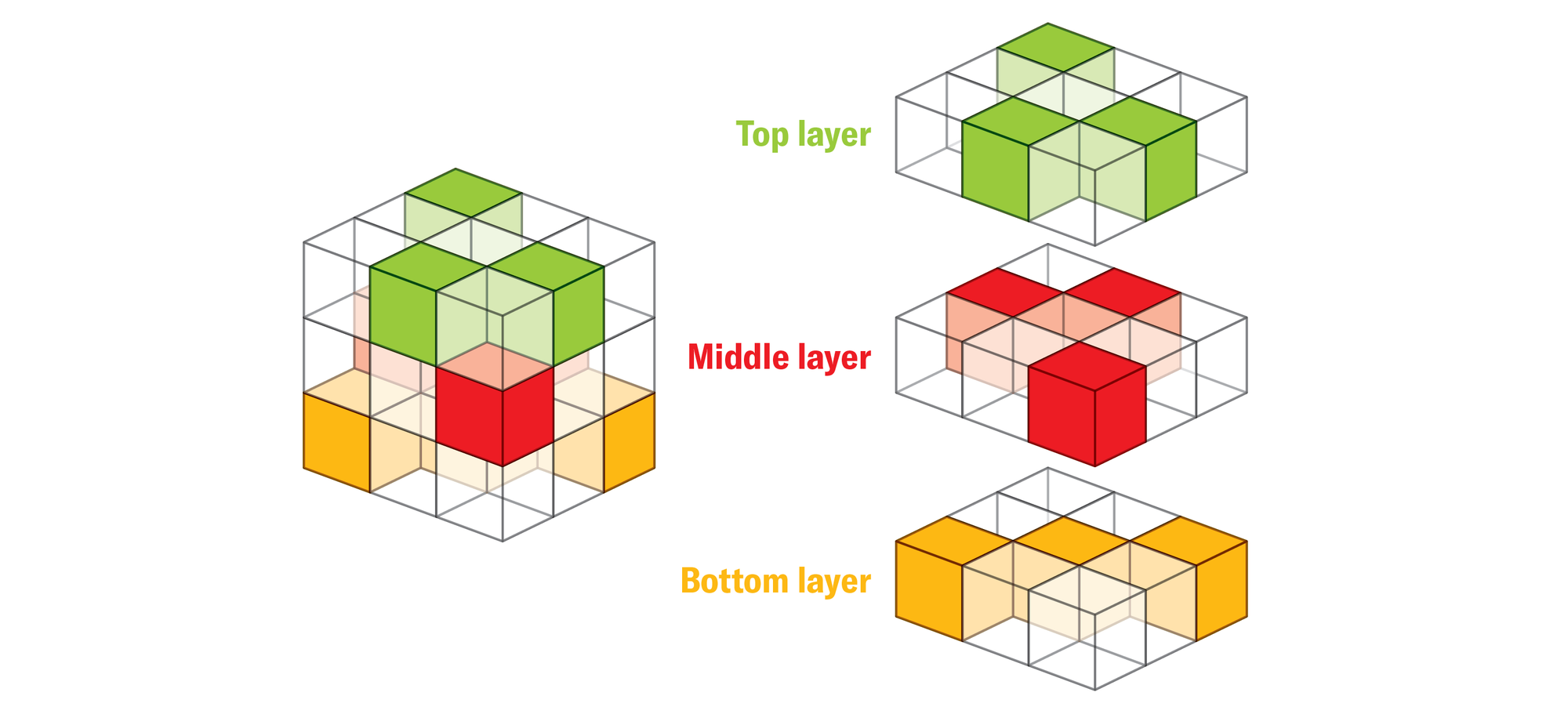
The preceding graphic represents each layer of our solution in a view from above. Every layer has the key property that exactly one cubelet resides in every row and column. This ensures that the corresponding strips on the two wall shadows remain intact. As an example, consider the red middle layer’s effect on the two wall shadows. It will cast a 1×3 strip in the middle of both wall squares because there’s a red cubelet to block the side lights in every row and column.
Furthermore, the floor shadow remains full as well because each of the nine cubelets occupies a different cell in the 3×3 grid. In other words, overlapping the three layers leaves no empty cells, meaning that there’s a cubelet blocking the overhead light in every pillar of the cube.

We cannot achieve this with fewer than nine cubelets because the Rubik’s Cube has nine distinct rows, nine distinct columns and nine distinct pillars. Eight cubelets would necessarily leave a hole.
A grid with this property—that every row and column contains each color exactly once—is called a Latin square. Latin squares exist for grids of all sizes, so our solution generalizes to any dimension of cube. You can translate any Latin square into a minimal arrangement of cubelets for this problem. Amazingly, this means that a cube comprised of a billion cubelets (1,000×1,000×1,000) can retain its shadows even if we discard 999 million pieces.
We’d love to hear from you! E-mail us at games@sciam.com to share your experience.