

Amanda Montañez
If the cards shown here are rearranged to form four new poker hands of five cards each, what is the lowest possible winning or tying hand?
When two hands are of the same type, such as a pair or a flush, first check the cards involved in the pattern. The higher rank wins—for instance, KKKK10 beats QQQQJ. If the cards involved are the same, check the next-highest card in the hand—KKAJ10 beats KKQJ10. If the hands are exactly the same except for the suit, it’s a tie.
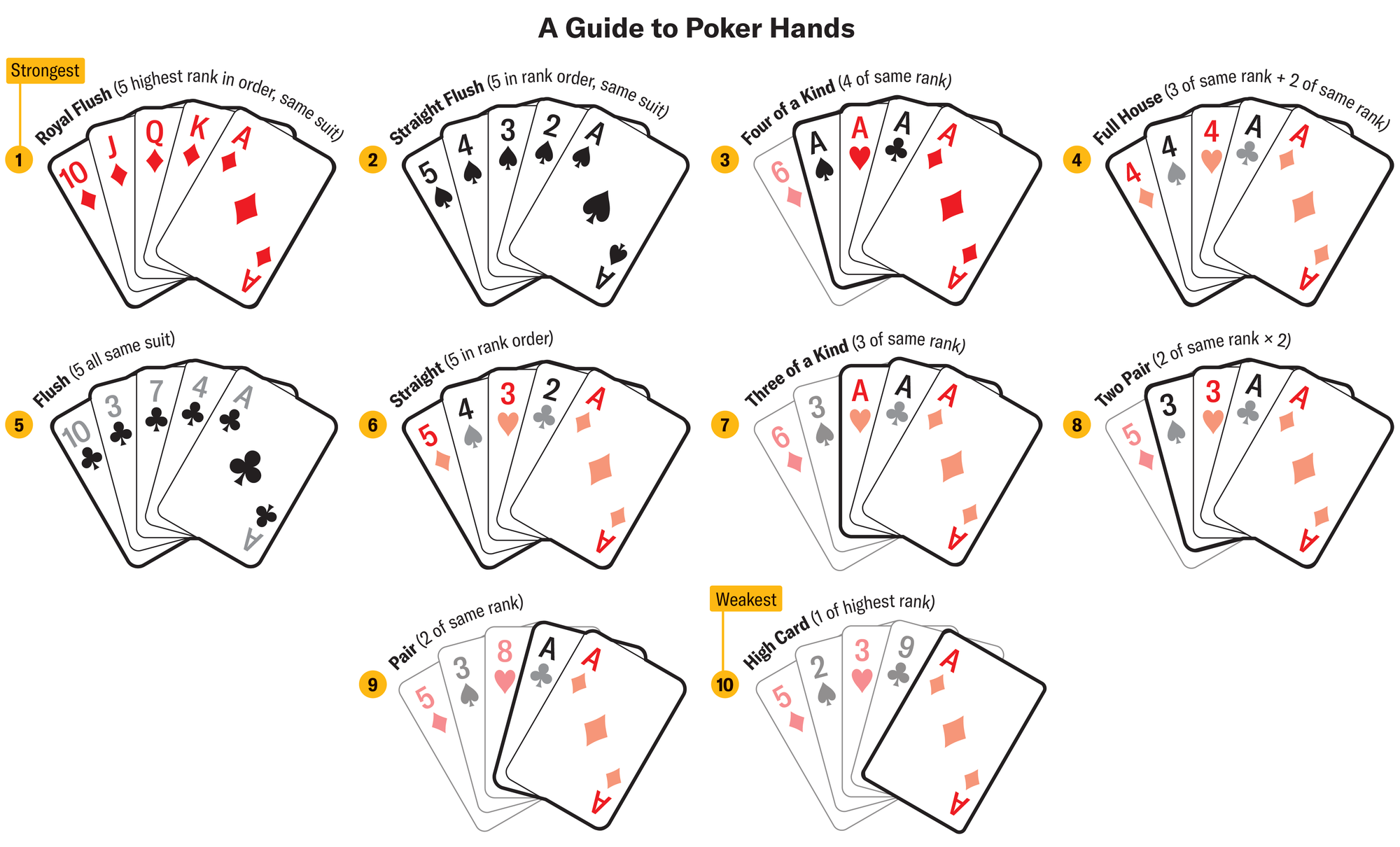
If you need a refresher on the poker hands, see the graphic below. (And for more on poker strategy, check out our tie-in article: The Math behind a Perfect Poker Deck
Amanda Montañez
The lowest possible hand overall is 10 10 JQK. Because there are only five ranks, picking five different cards in a hand to avoid a pair will necessarily result in a straight (five cards in a row).
The lowest possible winning hand has the cards in this configuration, where hands 3 and 4 are tied for winner:
Hand 1: 10 10 QKA
Hand 2: 10 10 QKA
Hand 3: JJQKA
Hand 4: JJQKA
We’d love to hear from you! E-mail us at games@sciam.com to share your experience.