"The Heavens Declare the Glory of God"
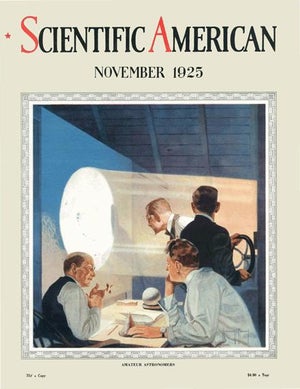
How a Group of Enthusiasts Learned to Make Telescopes and Became Amateur Astronomers
You are currently logged out. Please sign in to download the issue PDF.
How a Group of Enthusiasts Learned to Make Telescopes and Became Amateur Astronomers
A Report of the Scientific American Gold Test
How the Lie Is Punctured and the Criminal Exposed Is Described in This Interview With the Noted Criminologist, Edward O. Heinrich
The Wrecking of This Superb and Well-tried Ship by a Furious Thunderstorm
Physicians Have Found a New Way to Reach and Combat Some Microbes
Professor of Astronomy at Princeton University Research Associate of the Mount Wilson Observatory, California
A Study of the Developing Hair Through the Microscope Reveals the Secrets of Color Production and Color Loss
Radio Is Proving Its Usefulness in the Form of a Powerful Weapon Against Criminals
The Discovery of Insulin and the New Ductless Gland Therapy
With the Aid of a Remarkable Mathematical System These Early Americans Determined the Equinoxes and Closely Predicted Eclipses of the Sun and Moon
A Diesel Engine Installation With Greatest Flexibility and Ease of Operation, in a Most Demanding Service
Unbroken Rail Journey from San Francisco to Mexico City, Will Soon Be Possible
The Difficulties of Enforcement from the Traffic Officer's Point of View
How One Insect Combining Both Sexes Resulted from an Accident to Its Sex Chromosomes
Photographs Courtesy of Gardener's Chronicle
A Department of Facts and Notes of Interest to Patentees and to Owners of Patent and Trademark Rights