Alaska is Mapped from the Air, May 1927
With Three Airplanes, a Government Expedition Did More Mapping in Alaska in Fifteen Days than Ordinary Surveyors Could Have Accomplished in Fifteen Years
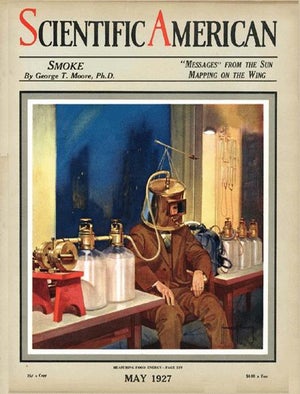
You are currently logged out. Please sign in to download the issue PDF.
With Three Airplanes, a Government Expedition Did More Mapping in Alaska in Fifteen Days than Ordinary Surveyors Could Have Accomplished in Fifteen Years
Our Ancient Ancestors Were Just as Keen About the Quality of Flint as We Are About the Quality of Steel. They Even Imported It From Long Distances
How Astronomers Imitate Stellar Temperatures of 36,000 Degrees, Fahrenheit
Even Though They May be Unable to Hear a Sound, the Pupils at a Famous New York Institution for the Deaf Soon Become Proficient with Band Instruments
How a Slender Stream of Rapidly Shifting Electrons Is Being Made to Trace a Complicated Record of a Lightning Stroke
A Review and Commentary on Progress in the Medical and Surgical Field
Strange "Messages" May Tell the Secrets of Fading and Other Radio Mysteries
The World Is Fast Waking Up to the Fact that There Is More of a Menace in Smoke than Has Been Thought. What Shall Be Done About It?
Sounds Are Now Reduced to Exact Mathematical Formulae and Reproduced at Will in the Acoustic Laboratory
In the Fifth Interview of This Series, an Inventor Tells How Ordinary Air Proved to Be a Stepping-stone to Prosperity
Even Their Ancient Enemies, the Cats, Were Found Powerless to Stop the Invasion of the Destructive Rodents
A Department Devoted to the Advancements Made in Industrial and Experimental Chemistry
A department devoted to the presentation of useful ideas wherein will be found material of practical value for those who are mechanically inclined