Night Flying With Safety
Made Possible By the Men Who Keep the Beacon Lights Burning Along Our Airways
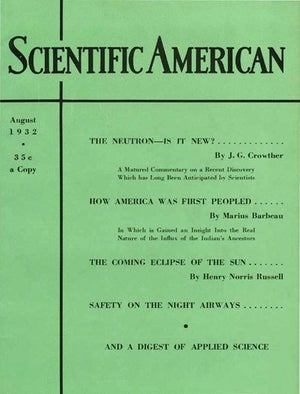
You are currently logged out. Please sign in to download the issue PDF.
Made Possible By the Men Who Keep the Beacon Lights Burning Along Our Airways
With the discovery of the neutron, science now has one more physical entity to juggle with. Though some of the press appears several weeks ago to have given the impression that the neutron was a brand new lucky strike, physicists have suspected for years that some such thing was "hiding out" and if sought would sooner or later be brought to light by experiment. The accompanying discussion is more mature than it could have been had it been written earlier. It was especially prepared for the SCIENTIFIC AMERICAN by a writer, himself a Cambridge man, who is in close personal touch with the principals now engaged in the brilliant researches going on in the famous Cavendish Laboratory at Cambridge University, England.—The Editor.
Some weeks ago the scientific world was most agreeably surprised when word was flashed across the Atlantic that two young English physicists, Dr. J. D. Cockcroft and Dr. E. T. S. Walton, working in the Cavendish Laboratory of Physics at Cambridge, had split the atom, effected a transmutation of elements and as a by-product had succeeded in releasing some of the higher intra-atomic energy concerning which a great deal has been prophesied during the past three decades. The accompanying article is largely a commentary on that striking bit of news, which may later prove to have contained inestimable significance not alone in pure science but to the world at large. —The Editor
Longest of Its Kind in the World
A booklet entitled "Total Eclipse of the Sun, August 31, 1932," obtainable from the Superintendent of Documents, Washington, D. C. for 25 cents (stamps not acceptable), contains detailed meteorological and astronomical data on the eclipse, with a large map. A last-minute circular from the United States Naval Observatory indicates a shift of the path of totality westward by approximately seven tenths of a mile.
Safe Harbor, Linked With Conowingo and Holtwood Plants, Completes Harnessing of Historic Eastern River
Herculaneum Emerges From Solidified Mud
Ancient Oriental Horticultural Dwarfing Methods May Be Applied to Common Fruit Trees