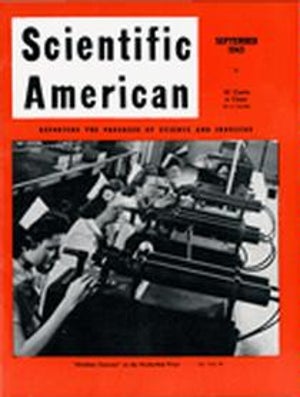
Scientific American Magazine Vol 169 Issue 3

Scientific American Magazine

Volume 169, Issue 3

You are currently logged out. Please sign in to download the issue PDF.

Features

Electronics' Brightest Star

A Demonstration of Popping Corn Without Heat Has Led to the Development of Electronic Methods of Heating Many Materials --Metallic and Non-Metallic -- by Means of High Frequency Currents. Present Applications are Relatively High in Cost, Yet Bring Many Industrial Advantages

Keith Henney

Dollars From Sewers

Modern Purification Techniques Have Advanced to the Point Where Valuable By Products are Obtained from Sewage Treatment Processes. Fertilizer, Gas, Grease, and Processing Water are "Manufactured" from the Liquid Wastes Collected in Sewers

Edward J. Cleary

What is Hardness?

Strictly Speaking, Science Doesn't Know. There's Much More Philosophy to the Subject Than Meets the Eye. We Have Testers that Measure Hardness--or so We Think--and then We Define Hardness on a Basis of their Methods, Rather than Vice Versa

S. R. Williams

Hard, Corrosion-Resistant, Slippery

The Story of the Conversion of That Popular Glamour Metal, Chromium, to an Essential Machine-Shop Material for the Production Front-Some of its Unsuspected Properties and New Uses, its Conservation Aspects, and its Future Place Among Industrial Materials

Fred P. Peters

Synthetic Rubber Today

Enough Can Now be Told About Synthetic Rubber to Indicate that the Problem of Replacing Natural Rubber in Many Vital Applications Will be Solved Satisfactorily. A Resume of the Most Important Synthetics, Their Composition and Qualities, and Raw Materials Used

James M. Crow

Floating Airports in Mid-Ocean

Reported Many Years Ago in these Pages, the Armstrong Seadrome is Row Assuming Added Importance in the Scheme of Things to Come in Aviation. Based on Sound Engineering Principles, the Seadrome Will Make Possible Over Ocean Air Transportation with Land Type Planes

Alexander Klemin

Dyes Will Be Even Better

Freed by Intensive Research from Dependency on Foreign Sources, the American Dyes Industry is Now Contributing Largely to the Development of All Branches of the Chemical Industry. After the War it Will Be Producing New and Improved Products for Peacetime Consumption

J. H. Sachs

Departments

Previews of the Industrial Horizon, September 1943

50 Years Ago, September 1943

Quotes, September 1943

New Products, September 1943

Current Bulletin Briefs, September 1943

Telescoptics, September 1943

Our Book Corner, September 1943