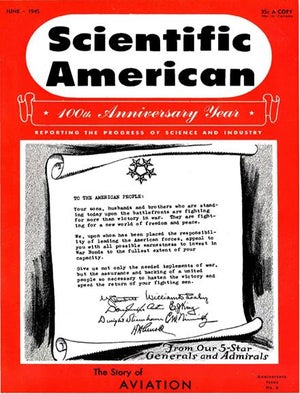
Scientific American Magazine Vol 172 Issue 6

Scientific American Magazine

Volume 172, Issue 6

You are currently logged out. Please sign in to download the issue PDF.

Features

Since Man Took Wings

To Fly has been the Persistent Dream of Man Down through the Ages, and in the Present Epoch that Dream has been Completely Fulfilled, but with Greater Consequences of Destruction than of Good. It Remains for Man in the Future to Make Achievement of Flight Entirely Beneficial

Alexander Klemin

Bearing Down on Friction

Certainty of Action Under Varying Conditions, Plus Savings in Power, are Two of the Ways in which Anti-Friction Bearings Are Making for Faster and More Accurate Production in American Industry. To Gain these Great Advantages, Scrupulous Maintenance is Needed

Plastics Aloft

From Practice Bullets to Helicopter Parts, From Structural Materials to Electrical Insulators, Many Kinds of Plastics Are Essential to Aviation Today and Tomorrow. They are Both Utilitarian and Decorative

Charles A. Breskin

Motor Vehicles Post-War

Will Aircraft Manufacturers Invade the Automotive Field? Will Motor Car Makers Produce Airplanes? Where Will the Parts Manufacturers Fit Into the Picture? Investors and Technicians Alike Want Answers to these Questions, Based on Logic and Established Fact and Experience

Leslie Peat

Flying Electronics

Safety and Consistency of Operations are Two of the Factors of Aviation Which Can be Promoted Rapidly Through the Use of Proved Electronic Devices. Plans of the CAA for Post-War Flying Embrace Radio Equipment that Will Give Aid to Both Commercial and Private Pilots

Keith Henney, Vin Zeluff

Engines of the Air

Kerosine Lamps, Exploding Because of Gasoline in the Burning Oil, Paved the Way for the Development of the Gasoline Engine. At First there was a Surplus of Fuel; then Chemists were Hard' Put to Produce Enough Efficient Fuel to Meet Demands of Automobiles and Airplanes

D. H. Killeffer

Lubricants for Air Power

Airplane Engines, Operating at High Temperatures, Need Strong Oil Films to Protect Moving Parts. Careful Research by the Petroleum Industry Has Produced Lubricants that not only Resist Deterioration under Severe Conditions, but also Carry Away Heat from Pistons

B. W. Story, E. A. Martin, Jerome Campbell

Soft Dies . . . Hard Jobs

Developed Originally by the Aircraft Industry to Improve Design Flexibility, Speed Production, and Lower Die Cost for Short-Run Work, the Use of Zinc Alloy Dies for Sheet-Metal Forming has Established Itself as Permanent Tooling and is Invading Other Fields as Well

Fred P. Peters

Better Television

Plastics Mirrors and Lenses Have Overcome Many of the Difficulties of Working Large Glass Surfaces. Combined With High-Voltage Cathode-Ray Tubes, These Plastics Parts Make Possible Post-War Television Receivers that Produce Large Pictures Free from Interference

Departments

Previews of the Industrial Horizon, June 1945

50 Years Ago, June 1945

New Products and Processes, June 1945

Current Bulletin Briefs, June 1945

Our Book Corner, June 1945

Telescoptics, June 1945