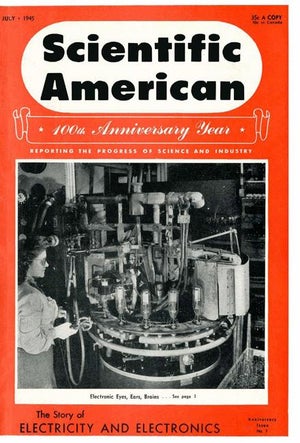
Scientific American Magazine Vol 173 Issue 1

Scientific American Magazine

Volume 173, Issue 1

You are currently logged out. Please sign in to download the issue PDF.

Features

100 Years of Electricity and Electronics

Less them the Span of a Single Century Covers the Lifetime of Applied Electricity. From Early Developments in an Obscure Art has Come the Science of Electronics, Taking Over Many Jobs in Industry and Doing Them Better than Ever Before. A Glimpse of the Future

Vin Zeluff, John Markus

It Pays to Listen

Wire-Recording Equipment and Other Electronic Instruments are Giving New Ears to Factory Men. New Accuracies in Machine and Process Industries, Made Possible by Studying and Comparing Noises, Are Speeding Production, Improving Quality, and cutting Costs

Edwin Laird Cady

Better Plastics Heating

In Wood Fabrication and in Preparing Plastics Materials for Molding, High Frequency Heating is Well into the Development Stage. The Success that Has Been Attained Bids Fair to Influence Favorably The Rapid Production of Even Large and Complicated Plastics Ports

Charles A. Breskin

Control in the Air

Electronics Has Brought to Aviation a Versatile Means of Controlling Many of the Airplane's Essential Mechanical Components. Increased Engine Efficiency, Reduced Pilot Fatigue, and Greater Safety are Some of the Worthwhile Results that Have so Far Been Obtained

Alexander Klemin

Gas in Bottles

Liquefied Petroleum Gas, Because of its High Thermal Efficiency and Adaptability to Convenient Storage and Transportation, has Come to be an Important Factor in American Economy, Both Domestic and Industrial. Its Uses are Widely Varied and They are Increasing Rapidly

Budd Mulloy, Jerome Campbell

Power Plants on Wheels

Comfort in Modern Passenger Trains Requires Large Quantities of Electric Power Put to Work in Many and Diverse Ways. On Most Trains, this Needed Energy Is Produced by Cor-Mounted Generators Driven by the Axles. Other Methods Are Also Used

A. G. Oehler, C. B. Peck

Industry's Permanent Pull

Modern Permanent Magnetic Alloys, Two to Ten Times More Powerful Than Former Materials, are Responsible for Compact, Efficient War-Time Energy-Converting Devices and Will be the Key Elements in Many Post-War Electrical and Electronic Products

Fred P. Peters

Infra-Red in Industry

By Harnessing Forces that Act Outside the Bounds of Human Senses, and Applying Electronic Amplification, Chemical Control Methods Have Been Highly Refined. The Infra-Red Technique is Not Yet in Wide Use, but Successful Results So Far Point to Broad Future Fields

D. H. Killeffer

Cathodic Protection

Pipelines and Other Underground Metallic Structures are Constantly Subject to Corrosion Caused by Galvanic Currents. Control of Such Corrosion Can be Obtained by the Use of Buried Anodes Which Set Up Counter Potentials. Masses of Magnesium Offer a Ready Solution

L H Woodman

Departments

Previews of the Industrial Horizon, July 1945

50 Years Ago, July 1945

New Products and Processes, July 1945

Current Bulletin Briefs, July 1945

Our Book Corner, July 1945

Telescoptics, July 1945