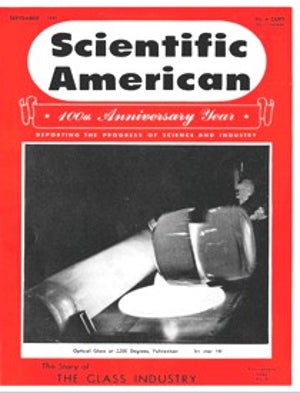
Scientific American Magazine Vol 173 Issue 3

Scientific American Magazine

Volume 173, Issue 3

You are currently logged out. Please sign in to download the issue PDF.

Features

Light and Progress

Glass, Material of Many Uses, Has Extended Man's Sight Into the Far-Off Universe and Into Microscopic Worlds. At the Same Time it Has Served Utilitarian Purposes in the Home and in Industry. Strangely Enough, it Was One of the Last of Present-Day Materials to be Adapted to Mass Production Methods and Hence Put to Wide Use

Jerome Campbell

Cutting Oil Comes Back

Plain Water, Water-and-Oil Mixtures, and Straight Oils All Have Helped to Speed Machining Processes and Make Them More Accurate. Every Time Tool Materials Changes Seemed to Point to the Possibility of Eliminating Cutting Oils from the Machine, It Was Found that Better Work Could be Accomplished by Keeping Them on the Job

Edwin Laird Cady

Plastics Sandwiches

Laminated Structures, Made of Glass Cloth Combined With Synthetic Resins, Have Proved Practical for Aircraft Sections. New Production Techniques Have Been Evolved Which Presage Wide Use of these Glass-Plastics Sandwiches in Many Industrial and Domestic Applications

Charles A Breskin

Gas Turbine PossibiIities

Will Airplanes of Tomorrow be Powered by Reciprocating Engines, by Turbo-Jets, by Turbines Driving Propellers, or by Some Combination of these Systems? Analysis of Present Technology Indicates that Each System Will Find its Place in Meeting the Varied Requirements of Flight

Alexander Klemin

Fuels for Jets

Reaction Engines for Aircraft Seem Capable of Operating Efficiently on Simple Fuels. But it May be that this Simplicity is as Yet Due to a Lack of Knowledge of the Means for Obtaining Highest Efficiency from the Power Plants that Will Operate the Aircraft of Tomorrow

D. H. Kilieffer

Glass and Electronics

Glass Has Played a Vital Role in the Development of Electronics. Now Electronics is Reciprocating by Providing a Flexible Tool for the Glass-Working Industry Whereby Welded Glass Products Can be Produced With High Precision and Sharply Localized Melting Areas

Keith Henney, vin Zeluff

Glass-Metal Collaboration

From Mirrors to Industrial Pumps, Various Combinations of Metals and Glass Have been Developed to Serve Specific Purposes and to Solve Difficult Problems. The Electrical and Chemical Industries Find Many Uses for Such Partnerships, Retaining the Best Features of Each

Fred P. Peters, Kenneth Rose

Turbines on Rails

At Operating Speeds, the First Locomotive In America to be Driven by a Steam Turbine Geared Directly to the Driving Wheels Compares Favorably With the Most Economical Reciprocating Units. A New Era of Rail Power May be in the Making as this Locomotive Accumulates Mileage. The Unique Gears are Being Carefully Watched by Engineers

C. B. Peck

Solarization

Glass in Ultra-Violet Lamps Tends to Deteriorate or Solarize as the Lamps are Used. A New Glass Has Now Been Developed which Transmits Ultra-Violet Radiation Freely but Does Not Solarize. How it Was Determined that Alkali in Glass is the Cause of Solarization

Harvey C. Rentschler

Departments

Previews of the Industrial Horizon, September 1945

50 Years Ago, September 1945

New Products and Processes, September 1945

Current Bulletin Briefs, September 1945

Our Book Corner, September 1945

Telescoptics, September 1945