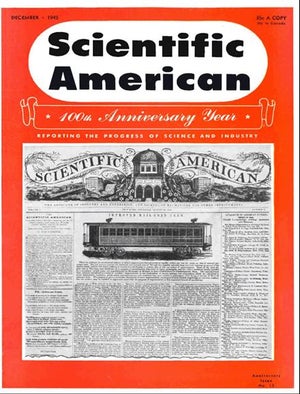
Scientific American Magazine Vol 173 Issue 6

Scientific American Magazine

Volume 173, Issue 6

You are currently logged out. Please sign in to download the issue PDF.

Features

A Century of Scientific American

Founded as a Serious Newspaper for All Americans Whose Interests Were Scientific, Mechanical, and Inventive, Scientific American Grew up with America's Great Age of Invention and Took Prominent Part in that Age. Its Main Aim Has Always Been to Report Technological Progress, Especially as it May Affect Industry

Albert G. Ingalls

Lost Wax at Work

Precision Castings Can be Produced Commercially by the Lost-Wax Process, but Not by "Off-in-the-Corner" Methods. Materials, Processing, and Equipment Must be Fitted to the Job in Hand; then Lost Wax Can Show Outstanding Advantages in Accuracy and Scrap Reduction

Edwin Laird

Your Home in Plastics

Combining Utility With beauty, Plastics Provide the Modern Small Home With Transparent and Radiant Walls, Giving the Illusion of Greater Size to Small Rooms. Plastics are Used for Curtain Rods, Colorful Door Knobs, Drawers, Trays, Tables, Chairs, and Bath Fixtures

Charles A. Breskin

Two-in-One Materials

Plating, Hot Dipping, Powder Metallurgy, Inserting, and Cladding, Offer Virtually New Materials With Desirable Properties for Many Specific Purposes. Plastics Plus Metals and a New Aluminum-Cast-to-Steel Process Open Many Fields of Application Hitherto Undeveloped

Fred P. Peters

Research for Small Business

A Little Research into Effective Means of Utilizing Research Reveals that Small Businesses Can Put Themselves on a Par With Big Business By Making Use of Available Facilities. Government Research Must Benefit All and Hence Must Fail in at Least One of its Avowed Purposes

D. H. Killeffer

Economics of Electronics

Much of the Enthusiastic but Misguided Publicity Given to Electronics May Prove a Boomerang to Acceptance of Really Worthwhile Developments. Uses of Electronics, Especially in Manufacturing Techniques, are Almost Unlimited, but Require careful and Responsible Development

John Markus, Keith Henney

Flying Aids

Aviation Gas Stations--Complete With Fuel, Oil, and Information Service--Offer Increased Safety and Convenience to the Pilot. A Number of Combination Automobile and Aircraft Stations Have Their Own Flight Strips. Fire-Fighting Equipment Adds to Overall Safety

Alexander Klemin

Power Brakes

Motor Vehicle Brakes, on the Average, Must Absorb Ten Times as Much Energy as the Engines Develop. Despite the High Energy Absorption of Airplane Brakes, They Are Not Yet Adaptable to Automotive Use. Current Limits of Braking Systems Must be Overcome in the Future

Leslie Peat

More Oil From Wells

A Method of Horizontal Drilling, Using a Turbine-Operated Bit, Holds Promise of Opening New Oil Horizons. Applied to Old and Seemingly Exhausted Wells, this New Procedure May Make Available Millions of Barrels of Oil that Otherwise Would Remain in the Earth

Wesley D. Archer

'Mightiest Nothing'

Helium, Best Known for its Use in Airships, is Being Developed for Many Other Purposes; Today it Finds Important Applications in Deep-Sea Diving, Medicine, and Welding as Well. What of the Future?

Lewis Nordyke

Departments

Previews of the Industrial Horizon, December 1945

50 Years Ago, December 1945

New Products and Processes, December 1945

Current Bulletin Briefs, December 1945

Our Book Corner, December 1945

Telescoptics, December 1945