Scientific American Magazine Vol 174 Issue 3

Scientific American Magazine

Volume 174, Issue 3

You are currently logged out. Please sign in to download the issue PDF.

Features

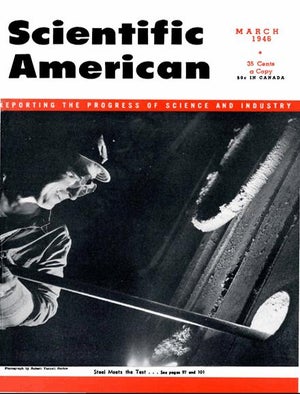
Steel Fights Back

A Basic Industrial Material, Steel is Assured a Continuance of Its Top Position by New Production Methods, by Specifications Tailored to Definite Industrial Needs, and by Its Inherently Adaptable Qualities. War-Time N.E. Steels have Proved Themselves and Are Here to Stay

Fred P. Peters

Detecting the Invisible

Sub-Surface Flaws are Revealed and Their Location and Size Determined by Non-Destructive Inspection with Supersonic Frequencies Formerly Used to Trace Submarines. Electronic Mine-Detectors, Also War Products, May be Ideal for Scouting Pipe and Cable Laying Projects

John Markus, Keith Henney

Plastics in 1946

Finding its Best Market in a Diversified Group of Other Industries, the Plastics Industry Looks Forward to a Busy Year. Production, Still Somewhat Limited by Materials and Equipment Shortages, is Expected to Smooth Out Soon. Will All-Plastics Cars be Forthcoming Eventually?

Charles A. Breskin

A New Eye for Industry

Millionth of a Second X-Ray Equipment Has Been Built Which Can be Directly Applied to Great Numbers of Practical Industrial Uses. Its Ability to Watch High-Speed Machinery in Motion May Practically Influence Present-Day Machine Design, Use, and Maintenance Techniques

Edwin Laird Cady

Fuels Rated by Performance

Aimed at New Motoring Pleasure and Economy, Borderline Knock Tests in Petroleum Research Use Road-Performance as the True Criterion of Fuel Quality. Present Cars also Benefit, But Gasolines of Aviation Quality, Tailored to Automotive Needs, Call for Better Engine Design

E. F. Lindsley

Air Transport Progress

Passenger Comfort, Cargo Handling, Navigation and Traffic Control, All Involve Problems Basic to Full Realization of Air Transport's Potential Value. Specialists from Other Fields-Biomechanics, lighting, and Even Air-Conditioning-are Enlisted to Add Comfort and Safety

Alexander Klemin

Ion Exchange

Purification of Liquids and Gases, Selective Recovery of Valuable Materials, and the Removal of Undesirable Substances from Chemical Compounds, are Problems that Often may be Solved with Ion Exchange Resins. Both Industry and the Laboratory Find These Resins Valuable

D. H. Killeffer, Howard C. E. Johnson
Keeping the Heat In

Chemically Inert, Light, Strong, and a Highly Efficient Insulator, Magnesia, Mixed with Asbestos Fibers, Provides an Easily Installed Insulating Material for Boilers, Pipes, and Similar Surfaces. Above 600 Degrees, a Lining of Diatomaceous Earth Protects the Magnesia

Departments

50 and 100 Years Ago, March 1946

Previews of the Industrial Horizon, March 1946

New Products and Processes, March 1946

Current Bulletin Briefs, March 1946

Our Book Corner, March 1946

Telescoptics, March 1946