Is the Atomic Bomb an Absolute Weapon?
P. M. S. Blackett maintains it is not, and derives therefrom some unusual conclusions. A reply to his argument follows on page 16
You are currently logged out. Please sign in to download the issue PDF.
P. M. S. Blackett maintains it is not, and derives therefrom some unusual conclusions. A reply to his argument follows on page 16
Challenging the Briton's strategic assumptions, he argues that a sudden air attack on military objectives would be decisive in any future war
Investigators at the University of Montreal have observed physiological changes in animals subjected to stress. Do similar changes take place in the harassed human animal?
On its majestic journey through space the Earth passes through a harsh rain of atomic particles. Presenting a brief review of what is now known about the phenomenon
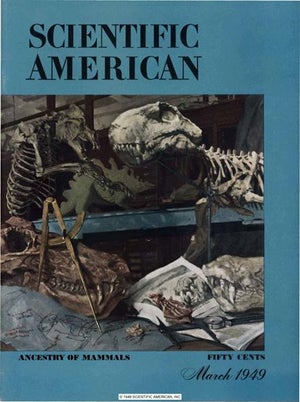
In the Permian and Triassic Periods lived the therapsids and the ictidosaurs, a curious group of reptiles with many mammalian characteristics
It does not exist, but the fundamental problem has been solved. When a practical model has been built, it will open some doors closed to electrons and light
Cooperation and competition are familiar institutions of the plant kingdom. Some plants make use of a form of antisocial behavior to inhibit their competitors
This month he is 70. It is an appropriate time to reflect on his achievements and to consider the present state of the work he began in 1905