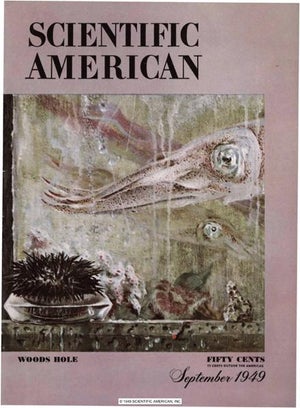
Woods Hole in 1949
The Cape Cod resort is the summer capital of biology. This year, as usual, the pleasant ferment of the Marine Biological Laboratory has produced some noteworthy work
You are currently logged out. Please sign in to download the issue PDF.
The Cape Cod resort is the summer capital of biology. This year, as usual, the pleasant ferment of the Marine Biological Laboratory has produced some noteworthy work
It is not one but many diseases. Some dangerous epidemic forms of it are caused by viruses living in an intricate sequence of other organisms, including the horse and man
The meaningless cries of babies fall into some remarkably meaningful patterns, the study of which shows differences among girls and boys and children of various environments
The earth constantly receives broadcasts from the sun and the Milky Way. Yet the waves from the Milky Way are too strong to come from stars like the sun
Three fine Canadian documentaries portray the problems of rejection, hostility and excessive dependence
The great Russian physiologist was born 100 years ago this month. He caused dogs to salivate at the sound of a bell, and brought together physiology and psychology
Biochemists have traditionally labored to isolate and observe individual enzymes. The author describes significant new work which indicates that these biological catalysts act in concert
When the volcanic island exploded in 1883, its life was completely extinguished. Botanists have since observed a unique natural experiment in the propagation of plants