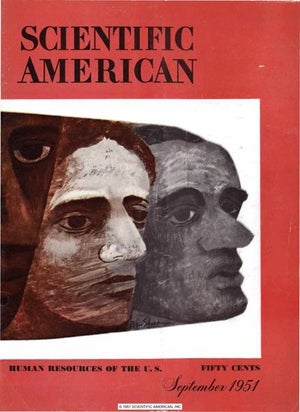
Volume 185, Issue 3
You are currently logged out. Please sign in to download the issue PDF.
Features
Population
In 50 years it has grown from 75 to 150 million. An account of its principal characteristics, how they have changed in the past and how they appear likely to change in the future
Labor Force
Sixty million Americans work for pay. Our increasing productivity per man-hour frees more and more of us for specialized occupations and at the same time accentuates the demand for trained personnel
Intellectual Resources
A million and a half Americans work primarily with their brains. The number of young people who are capable of such careers is finite, but we have not yet utilized them fully
Engineers
There are 400,000 of them, but they are in acutely short supply. An analysis of this critical situation, with some suggestions as to how it might be alleviated in the future
Scientists
We have 175,000 and need more. The problem is complicated by the fact that applied science takes workers away from pure sceince, the wellspring of our technological progress
Doctors
There are 209,000 M.D.'s. When we attempt to estimate whether we will have enough we must consider not only the demand for medical care but also the need for it
Mobilization
By 1952 we will have an armed force of 3.5 million. In the same time we must add 4.5 million workers to our arms production. Our biggest problem is to achieve this without weakening the nation
Youth
What lies beyond the full utilization of our human resources? Our best hope is to increase our educational opportunities and enlarge the fraction of our people capable of learning the higher skills