Smog
As the metabolism of our cities quickens, their inhabitants breathe increasingly polluted air. The study of the problem is unusually difficult, but good beginnings have been made
You are currently logged out. Please sign in to download the issue PDF.
As the metabolism of our cities quickens, their inhabitants breathe increasingly polluted air. The study of the problem is unusually difficult, but good beginnings have been made
Beside an ancient lake bed in Yorkshire archaeologists have unearthed stone and organic relics of the pre-agricultural folk who inhabited the forests of Europe 10,000 years ago
The motion of a conducting fluid in a magnetic field generates a hitherto unknown kind of wave. This may be a mighty force of nature which causes such phenomena as sunspots and cosmic rays
The great English physiologist, who died in March at 95, was also a remarkable writer. Presenting his poetic account of the eye and how it makes itself
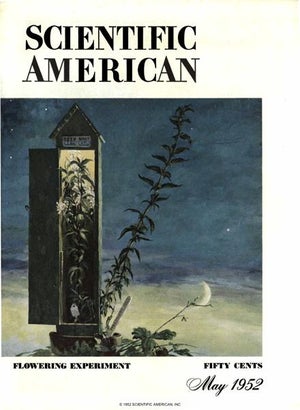
What makes a plant grow flowers instead of stems and leaves? Although the mechanism is not entirely understood, the study of it makes possible some interesting advances in agriculture
Electrons or protons from a fine needle reveal the architecture of crystals and resolve individual atoms and molecules
Concerning color blindness, tone deafness and certain lesser- known shortcomings of men and animals
Everything that moves over the surface of the earth-water, air, animals, machines and projectiles-sidles to the right in the Northern Hemisphere and to the left in the Southern