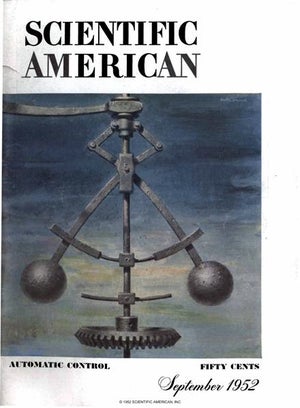
Automatic Control
An introduction to seven articles about self-regulating machines, which represent a scientific and technological revolution that will powerfully shape the future of man
You are currently logged out. Please sign in to download the issue PDF.
An introduction to seven articles about self-regulating machines, which represent a scientific and technological revolution that will powerfully shape the future of man
It is the fundamental principle that underlies all self-regulating systems, not only machines but also the processes of life and the tides of human affairs
Many machines already run themselves by feedback. A new species of engineer is now required to orchestrate a whole technological process and its controls in a unified system
The art of feedback control has attained its highest development in the modern petroleum refinery. Such refineries are not quite fully automatic, but in them we see the shape of plants to come
Feedback control has begun to advance in the working of metals. Presenting the first account of a milling machine that converts information on punched tape into the contours of a finished part
The multifarious control loops of a fully automatic factory must be gathered into one big loop. This can best be done by means of a digital computing mchine
The surprising discovery that it is subject to the same statistical treatment as heat facilitates its storage and handling in automatic control systems
What about the economic and social impact of automatic control systems? Can industry afford to buy them, and will they cause widespread technological unemployment?