Stonehenge
The strange monument is often attributed to the Druids of 2,000 years ago, but radiocarbon dating supports the view that it was started by a savage but aspiring people 2,000 years before that
You are currently logged out. Please sign in to download the issue PDF.
The strange monument is often attributed to the Druids of 2,000 years ago, but radiocarbon dating supports the view that it was started by a savage but aspiring people 2,000 years before that
As a means of seeing beneath the surface, the image-orthicon camera has many advantages. It needs relatively little light and can be lowered to depths far beyond the range of divers
It is enamel. Like hair and nails, this hard substance is made by epithelial cells. Once it was thought to be as inert as rock; now it is known to exchange its substance with the body fluids
The principal discovery made with the 200-inch telescope so far is that the yardstick by which we measure distance outside the Milky Way is twice as long as we had thought
It is a chemical process wherein the atoms of a metal in solution are "sequestered" by ring-shaped molecules. Chelating agents have now become important tools of analytical chemistry and technology
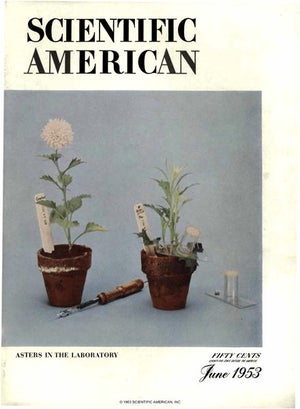
A disease of asters is caused by a virus that multiplies in both the plant and the insect which infects it. This makes the virus one of the few pathogens common to the plant and animal kingdoms
The pouched mammal is adaptable, clean, unintelligent, weighs less at birth than a paper match, gives rise to as many as 25 young in one litter and only occasionally devours its own tail
A brief account of where it occurs and how to get out of it. The principal point to remember when mired: lie down on your back so as to float atop the sand as you would on the water