Industrial Productivity
What determines how much a worker can produce in different periods and in different countries? The answer is found in the study of a sensitive ratio between the cost of labor and the cost of machinery
You are currently logged out. Please sign in to download the issue PDF.
What determines how much a worker can produce in different periods and in different countries? The answer is found in the study of a sensitive ratio between the cost of labor and the cost of machinery
The bottom off northern California is broken by a cliff a mile high and more than 1,000 miles long. It is one of four immense fractures apparently due to the same massive deformation of the earth's crust
Three thousand years ago the Hittites pushed south to invade Syria and Mesopotamia. They were unable to subdue their powerful western neighbor Arzawa, the remains of which are only now being excavated
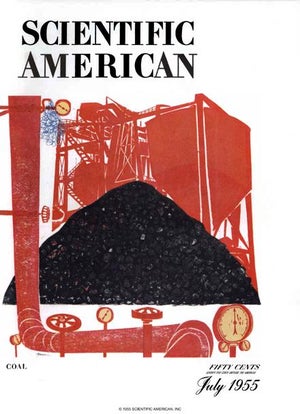
It is by far the largest store of fossil organic substance, but its utilization lags. Scientific and technological advances suggest that it might best be used not as a fuel but as a chemical raw material
Two weeks before Einstein died he was visited by a historian of science. They sat in Einstein's study and discussed some of his illustrious predecessors in the evolution of physics
Viruses provide a simple example of the basic process of biological change. Some recent experiments suggest that it may soon be possible to alter their inborn characteristics predictably by chemical means
Many important properties of metals are now understood to result from a kind of imperfection in crystal lattices that is called a dislocation. The theory is helping to transform metallurgy from an art to a science.
A number of land-dwelling animals can guide themselves by means of polarized light from the sky. Underwater light is polarized also, and some aquatic organisms may use it as an aid to navigation