The Universe
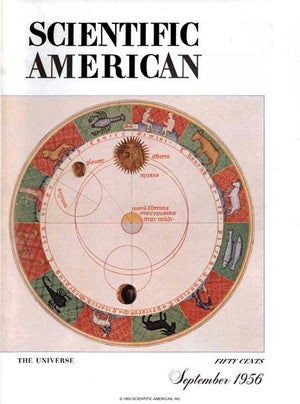
Presenting an issue about astronomy as it is related to cosmology: the study of the large-scale features of the cosmos. The following introduction traces the historic development of cosmological ideas
You are currently logged out. Please sign in to download the issue PDF.
Presenting an issue about astronomy as it is related to cosmology: the study of the large-scale features of the cosmos. The following introduction traces the historic development of cosmological ideas
The relative abundance of the various kinds of atoms is a powerful clue to the history of the universe. The author discusses the recent theory that the heavier ones were built up from hydrogen in stars
The discovery that there are two populations of stars illuminates the history of galaxies. Population II stars are old; Population I stars are still being born in the dusty arms of spiral galaxies
They have various forms: irregular, elliptical, spiral and barred spiral. The study of these structures, including that of our own galaxy, has led to a theory of their descent from a primordial gas
Many galaxies occur in clusters, the density of which is such that their members may be expected to collide occasionally. The results are discussed here and in the article on radio galaxies
Most cosmologists believe that the universe began as a dense kernel of matter and radiant energy which started to expand about five billion years ago and later coalesced into galaxies
Some cosmologists dissent from the evolutionary view, holding that the large-scale features of the expanding universe do not change, and that its density has been maintained by the creation of matter
The redness, and presumably the speed of recession, of most galaxies increases regularly with distance. The most distant galaxies observed appear to depart from this law, a fact of deep meaning for cosmology
The light of galaxies takes so long to reach us that photographs of the deep sky map them both in space and time. Mathematicians now seek a chance mechanism that will account for their pattern
As indicated earlier in this issue, colliding galaxies emit radio waves. The distribution of radio sources suggests that many are galaxies in collision beyond the range of the 200-inch telescope!
A historical epilogue to this issue. The argument: In earlier times the search for knowledge was handicapped by presupposed cosmological principles. Modern cosmologists must guard against the same tendency