The U.S. Patent System
The patent law both protects inventors and encourages the diffusion of inventions. The present law has not basically changed since 1836, and it is now proposed that new circumstances call for its revision
You are currently logged out. Please sign in to download the issue PDF.
The patent law both protects inventors and encourages the diffusion of inventions. The present law has not basically changed since 1836, and it is now proposed that new circumstances call for its revision
The earth is bathed in radio waves that appear to have originated at the time of the primordial "big bang." This radiation provides the cosmologist with a rare new clue to the nature of the universe
The first and largest city of the pre-Columbian New World arose in the Valley of Mexico during the first millennium A.D. At its height the metropolis covered a larger area than imperial Rome
Certain organic compounds can exist In two or more forms that have the same chemical composition but different molecular architecture. One of them is the basis for vision throughout the animal kingdom
There are a number of advantages to be gained from using a liquid as the active medium in a laser rather than a solid or a gas. Such devices may soon become competitive with more conventional lasers
In many parts of the world the pumping of oil, gas or water out of the ground has caused the land to sink. Where oil or gas are involved the subsidence can be forestalled by pumping in water
The hungry larvae of butterflies are selective in choosing the plants they eat. This reflects the fact that the evolution of both plants and the animals that feed on them is a counterpoint of attack and defense
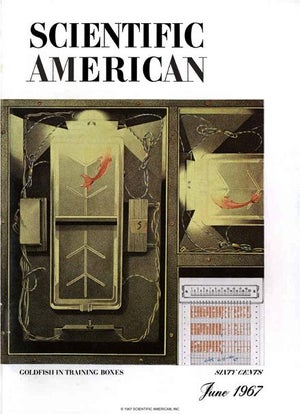
If a goldfish is trained to perform a simple task and shortly thereafter a substance that blocks the manufacture of protein is injected into its skull, it forgets what it has been taught