Science Policy in the U.S.S.R.
A new study shows that the U.S.S.R. operates a research and development establishment comparable in size to that of the U.S. The differences between the two are getting fewer
You are currently logged out. Please sign in to download the issue PDF.
A new study shows that the U.S.S.R. operates a research and development establishment comparable in size to that of the U.S. The differences between the two are getting fewer
Charged particles leave damage trails in nonconducting solids such as mineral crystals, glasses and plastics. The etched tracks provide information on the age of the solid or the nature of the particles
In man and other higher animals an intricate, three-step process involving a variety of cells renews injured tissue. Studies of this process could yield ways of controlling several diseases
The antinomy of the liar, a basic obstacle to an adequate definition of truth in natural languages, reappears in formalized languages as a constructive argument showing not all true sentences can be proved
The substance that attracts social amoebae to one another to form a sluglike mass has recently been identified. It turns out that the same substance also acts as a "messenger" in mammalian cells
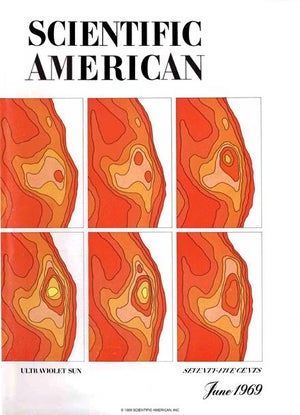
Telescopes now in orbit are measuring the ultraviolet radiation from celestial objects that never penetrates the earth's atmosphere. The results may significantly alter man's view of the universe
The reproductive behavior of this aquatic shorebird is most unusual. The female phalarope aggressively courts the male; the male phalarope warms the eggs and rears the young birds
Self-regulating manufacturing processes call for systems that sensitively monitor the performance of the process. An example of such a system is a gas chromatograph linked to a computer