Chemical and Biological Weapons
The U. S. has renounced all forms of biological weapons and the first use of most chemical weapons. The issue of whether or not to include irritant gases and antiplant agents in the prohibition remains open
You are currently logged out. Please sign in to download the issue PDF.
The U. S. has renounced all forms of biological weapons and the first use of most chemical weapons. The issue of whether or not to include irritant gases and antiplant agents in the prohibition remains open
The remarkable pictures taken by Mariners 6 and 7 reveal a planet with features unlike those seen on the moon and also unlike those on the earth, including a polar cap evidently composed of dry ice
Calefaction means warming, and the industrial warming of rivers and other waters is a cause of concern. A study of the warming of the lower Connecticut River, however, reveals no drastic effects
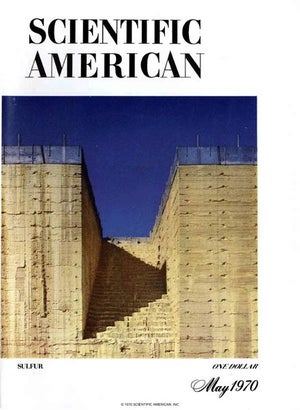
The demands of modern agriculture and industry have increased consumption of the element fortyfold since 1900. It comes from many sources, and some 87 percent of it goes to sulfuric acid
The cells of living tissue act in concert in various ways. A newly observed pathway may allow signal molecules to travel from one cell interior to the next through special junctions in the cell membrane
Until recently thermal waves analogous to "first sound", or ordinary acoustic waves, were thought to exist only in liquid helium. They have now been detected in solid helium and may occur in other substances
It depends on whether what we see is pictorial (scenes, photographs and so forth) or linguistic (words, numbers and so on). Experiments indicate that the linguistic memory is different from the pictorial
Greek philosophers first conceived an atomic theory of matter and scientists after the Renaissance speculated on interatomic forces. More detailed theories awaited 19th-century experimental results