Government Investment in Health Care
The delivery of health care will remain unsatisfactory and its cost will continue to rise until the U.S. invests in capacity for a real health-care system. That will require some hard political decisions
You are currently logged out. Please sign in to download the issue PDF.
The delivery of health care will remain unsatisfactory and its cost will continue to rise until the U.S. invests in capacity for a real health-care system. That will require some hard political decisions
The goal of seeing individual atoms with an electron microscope has been achieved with an instrument that extracts a maximum of information from the electrons after they strike their target
Stone tools in highland Peru indicate that men lived there 22,000 years ago, almost twice the old estimate. They also imply that the first cultural traditions of the New World had their roots in Asia
Automatic methods of interpreting patterns of various kinds are currently under investigation. An experimental reading machine that requires no prior knowledge of character shapes is described
Many organisms have a built-in circadian, or daily, clock. It has now been demonstrated that some also have a circannual, or yearly, clock that operates even when environmental signals are eliminated
Experiments designed to measure the effects of compression on the superconducting properties of certain metals may lead to the creation of new, higher-temperature superconductors
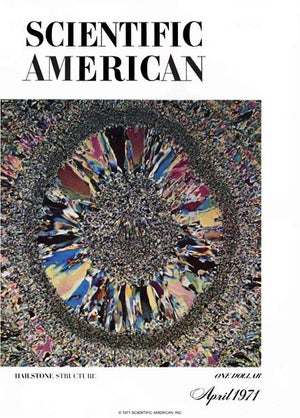
The internal structure of a hailstone tells the history of its formation. This structure is made visible by cutting a section of the stone and placing it between crossed polarizing filters
The goal is to locate a gene In relation to others and to establish which of the 23 chromosome pairs carries it. This is done primarily by applying statistical techniques to data on inheritance of traits