Fusion by Laser
Experiments indicate that energy-releasing fusion reactions can be initiated and to some extent controlled without a confining magnetic field by focusing a powerful laser pulse on a frozen pellet of fuel
You are currently logged out. Please sign in to download the issue PDF.
Experiments indicate that energy-releasing fusion reactions can be initiated and to some extent controlled without a confining magnetic field by focusing a powerful laser pulse on a frozen pellet of fuel
Recordings of the points inspected in the scanning of a picture and of the path the eyes follow in the inspection provide clues to the process whereby the brain perceives and recognizes objects
These fibers enable tissues such as skin, arteries and ligaments to stretch and rebound. Their two components have been separated, and their composition and mode of synthesis are being established
The way ultrahigh-energy electrons are scattered by protons and neutrons suggests that these "elementary" nuclear particles have a complex internal structure consisting of pointlike entities
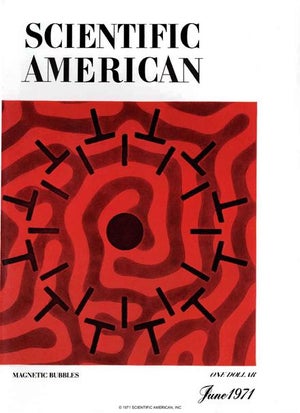
A magnetic material is divided into regions that are magnetized in different directions. These "domains" can be formed into small "bubbles" that can be utilized in a new kind of computer memory
The disorder has a long record because its principal sign is so apparent. it is now a disease of the poor, because an unbalanced diet often cannot correct for a deficiency of iodine in the soil
Tepe Yahya, midway between Mesopotamia and India, was a busy center of trade 5,500 years ago. An outpost of Mesopotamian urban culture, it played a key role in the spread of civilization from west to east
The society of the wild turkeys that live in the semiarid grasslands of southeastern Texas is so rigidly stratified that most of the males never have an opportunity to mate