An Experiment in Work Satisfaction
Boredom on the assembly line, reflected in high labor turnover and absenteeism, has stimulated efforts to find new ways of organizing work. The author describes one such experiment in a Swedish plant
You are currently logged out. Please sign in to download the issue PDF.
Boredom on the assembly line, reflected in high labor turnover and absenteeism, has stimulated efforts to find new ways of organizing work. The author describes one such experiment in a Swedish plant
An analysis of certain very powerful X-ray sources suggests that the radiation emanates from a binary system where a superdense collapsed star is orbiting closely around a massive normal star
Studies of how people communicate in solving problems assist progress toward the development of a conversational computer, with which the user could communicate as if it were a person
This great body of hot rock accounts for 83 percent of the volume of the earth and 67 percent of its mass. Although the mantle is inaccessible, much has been learned about it by indirect evidence
Color Vision depends on three types of cone cell, each containing one of three visual pigments. Those who are color-blind either lack one of the pigments or have an anomalous pigment in one type of cone
Copepods, ubiquitous marine crustaceans, store energy in the form of wax. It now seems that half of the organic nlatter synthesized by the sea's primary producers is conrerted for a time into waxes
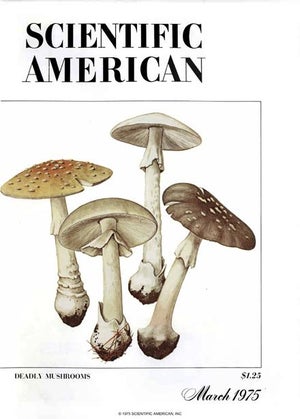
Certain fungi of the genus Amanita contain toxins of extraordinary virulence. They are ring-shaped molecules made up of amino acids, and they disrupt the membranes and the nuclei of cells in the liver
He showed that a body falling with a horizontal component of motion describes a parabola. It has been thought that he did so solely by principle, but it now appears that he conducted careful experiments