The Solar System
Presenting an issue on what is known about the sun and the bodies In orbit around it, with special reference to the knowledge gained In 18 years of exploration by space probes launched from the earth
You are currently logged out. Please sign in to download the issue PDF.
Presenting an issue on what is known about the sun and the bodies In orbit around it, with special reference to the knowledge gained In 18 years of exploration by space probes launched from the earth
It is generally agreed that some 4.6 billion years ago the sun and the planets formed out of a rotating disk of gas and dust. Eactly how they did so remains a lively topic of investigation
Recent spacecraft observations have revealed spectacular new features of the solar surface and atmosphere. What happens inside the sun, however, has lately become more mysterious
The remarkable pictures made by the spacecraft Mariner 10 have revealed a planetary paradox: Although Mercury is like the earth on the inside, it is like the moon on the outside
It is cratered like the rest of the inner planets, but its surface has been transformed by its dense and cloudy atmosphere. The clouds trap sunlight to maintain a temperature of 900 degrees Fahrenheit
The outstanding feature of our own planet is the dynamic activity of its atmosphere and its crust. Both have been substantially altered by the evolution of living organisms
Lacking an erosive atmosphere and geologically active outer layers, the earth's lifeless satellite has preserved a record of early events (but not the primordial events) in the history of the solar system
The first closeup photographs of it suggested that it was a cratered body as dead as the moon. Later pictures show a host of remarkable features indicative of a lively past
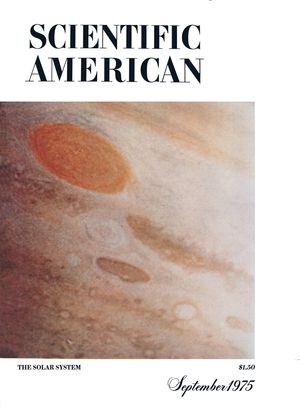
More massive than all the other planets put together, it consists largely of hydrogen and helium. Below its turbulent atmosphere the hydrogen forms two liquid layers, one molecular and one metallic
Beyond Jupiter are the remote unexplored planets: Saturn, Uranus, Neptune and Pluto. Saturn has a composition much like Jupiter's; Uranus and Neptune appear to be rockier. Pluto is a small maverick
They range in size from meteoroids no larger than a grain of sand to moons bigger than the planet Mercury. Many of them appear to be fragments resulting from collisions between growing planetesimals
A "wind" of charged particles blows out from the sun, punctuated by energetic bursts. These particles interact with the magnetic fields of the planets in intricate ways