The Strip-Mining of Western Coal
If the U.S. is to become self-sufficient in energy terms, it will have to take huge amounts of coal from the thick shallow deposits of the Western states. Can it be done without despoiling the land?
You are currently logged out. Please sign in to download the issue PDF.
If the U.S. is to become self-sufficient in energy terms, it will have to take huge amounts of coal from the thick shallow deposits of the Western states. Can it be done without despoiling the land?
The active transport of selected substances into the cell needs energy. Colicins, antibiotics made by bacteria, can stop active transport and can therefore be used to study how it is achieved
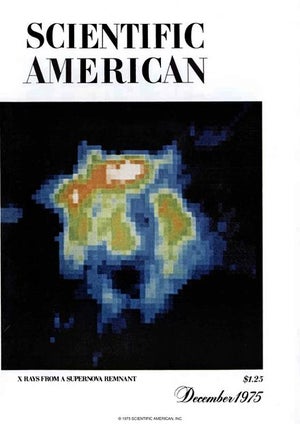
An exploding supernova hurls a shell of gas into the interstellar medium. In the region where the gas of the shell meets the gas of the medium, X rays are generated that yield information about both
Why does time never go backward? The answer apparently lies not in the laws of nature, which hardly distinguish between past and future, but in the conditions prevailing in the early universe
Senile cataract is caused by abnormal stress that is superimposed on the normal aging of the lens of the eye. Prevention will require more knowledge of the structure and metabolism of the human lens
Among the Koman peoples of Africa the bridegroom promises a sister to the family of the bride for marriage. The practice is an organic part of the economic, social and moral system
Future advances in the manufacture of synthetic polymers will depend not only on mastering their complex chemistry but also on finding new ways to control the arrangement of their molecules during processing
Australian species of the genus Bembix are unexpectedly diverse. One reason appears to be that they have evolved to fill ecological niches that in other parts of the world are filled by other genera