Scientific American Magazine Vol 234 Issue 2

Scientific American Magazine

Volume 234, Issue 2

You are currently logged out. Please sign in to download the issue PDF.

Features

The Ethics of Experimentation with Human Subjects

Research with human subjects has produced advances in medicine but also some instances of ethical abuses. Studies of the attitudes and practices of investigators suggest that better controls are required

Bernard Barber

The Receptors of Steroid Hormones

The cellular response to these hormones depends on the presence of protein molecules called receptors. The complex formed by the hormone and the receptor acts on the genetic material of the cell

Bert W. O'Malley, William T. Schrader

Is Gravity Getting Weaker?

Several theories of gravitation predict that the force of gravity diminishes as the universe expands. Preliminary results of timing eclipses of stars by the moon suggest that it may well be the case

Thomas C. Van Flandern

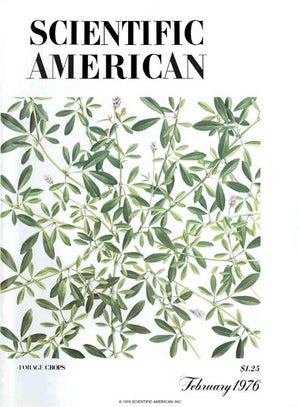
Forage Crops

Grasses and legumes that are fed to livestock are the mainstay of U.S. agriculture. Among their virtues is the fact that they can be grown on land that is not suited to growing other crops

Harlow J. Hudgson

Robot Systems

Instructable machines capable of performing simple human tasks are appearing in many factories. Some experimental robots are being taught how to cope with uncertainties in the environment

James S. Albus, John M. Evans Jr.

The Final Paleolithic Settlements of the European Plain

When the glaciers retreated, the climate of Europe became variable. Tundra gave way to forest and forest to tundra. The technology and social organization of the indigenous hunters changed accordingly

Romuald Schild

Carbenes

The basic reaction mechanisms of organic chemistry are probed with the aid of these extremely reactive, short-lived molecules, created by depriving a carbon atom of two of its normal bonds

Maitland Jones Jr.

The Biological Clock of Insects

With the approach of winter, insects enter into a state of dormancy. This shift in metabolism implies that they have a clock to measure changes in the length of the day. What is the nature of the clock?

D. S. Saunders

Departments

Letters to the Editors, February 1976

50 and 100 Years Ago, February 1976

The Authors, February 1976

Science and the Citizen, February 1976

Mathematical Games, February 1976

The Amateur Scientist, February 1976

Books, February 1976

Bibliography, February 1976