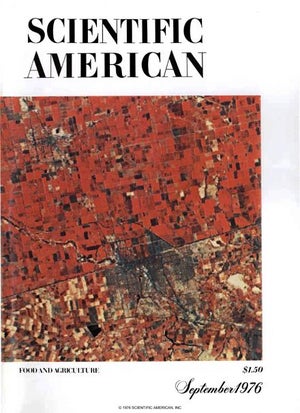
Food and Agriculture
Introducing an issue about the world food problem. The situation is hopeful, with one proviso: that the development efforts of agrarian countries be concentrated less on industry and more on agriculture
You are currently logged out. Please sign in to download the issue PDF.
Introducing an issue about the world food problem. The situation is hopeful, with one proviso: that the development efforts of agrarian countries be concentrated less on industry and more on agriculture
The number of people who are poorly nourished or undernourished can only be roughly estimated, but they probably represent an eighth of the human population. Most of them are found in Asia and Africa
Environmental, dietary and physiological factors all interact to set nutritional needs of individuals and populations. Recommended energy and nutrient allowances are thus statistical approximations
Energy and inorganic nutrients are processed for human consumption by plants, animals and microorganisms. Modern agriculture ensures man's food supply by subsidizing the growth of these other species
Over the past 10,000 years man has chosen a relatively small number of plants and animals for domestication. The process made the domesticated species and man mutually dependent
They are established by a combination of ecological, economic and cultural factors. The problem today is how the developing countries can promote high-yielding systems based on cereals
Its high productivity is a result of two centuries of development policy: low prices for land and other things needed for farming, stable prices for farm products and the promotion of innovation
The green revolution has been a notable success among Mexico's larger, more commercial farmers. Its benefits must now be extended to the majority of rural workers in the traditional farming sectors
The nation has done much better in feeding its great population than most outsiders realize. Increasing farm output still more may force hard choices among strategies of agricultural and industrial growth
The physical resources of earth, air, fire (energy) and water are large but are essentially fixed. The biological and social resources, however, are far from being pressed to the limit
The new technology of the green revolution brings larger harvests from a given area of farmland. The foundation of this technology is the breeding of crops adapted to the needs of intensive agriculture
The poor countries can feed themselves if their agriculture is modernized and their rural economies are restructured. That requires infusions of technology and capital from rich nations