Cruise Missiles
This new category of inexpensive, highly accurate weapons presents a diflicult but not insuperable problem to arms-control negotiators: how to distinguish reliably between strategic and tactical versions
You are currently logged out. Please sign in to download the issue PDF.
This new category of inexpensive, highly accurate weapons presents a diflicult but not insuperable problem to arms-control negotiators: how to distinguish reliably between strategic and tactical versions
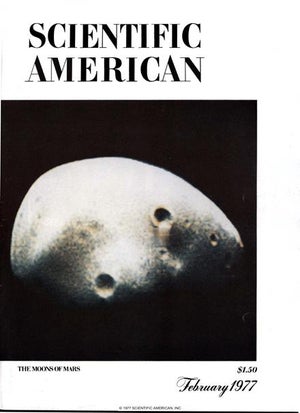
These tiny moons of the planet Mars have been viewed from close up by the Mariner and Viking spacecraft. They provide the first glimpse of the nature of the smaller bodies of the solar system
Vindolanda, near Hadrian's Wall, was a Roman garrison from the first century to the fifth. Oxygen-free burial has preserved a remarkable trove of wood, leather, textiles and writing in ink
A 12-year-old system provides more than 400 microwave pathways to 80 countries. Its eight satellites stationed over three oceans now account for some two-thirds of all transoceanic communications
The monoclonal hypothesis, which holds that the proliferating cells of an atherosclerotic plaque all stem from one mutated cell, suggests new lines of research on the causes of coronary disease
The isotopes of an element, ordinarily indistinguishable, can be sorted out in the monochromatic light of a laser. The process may make isotopes plentiful for medicine, research and nuclear power
In order to communicate effectively with others children must learn not only the language itself but also the use of social speech, which takes into account the knowledge and perspective of another person
When a nerve makes a muscle cell contract, it gives the cell a tiny squirt of acetylcholine. Receptors on the cell respond by opening so that ions can travel through the cell membrane