Underground Reservoirs to Control the Water Cycle
At any one time perhaps two-thirds of the fresh water on the earth is held in underground reservoirs. These reservoirs could be much more intensively drawn on, to be refilled when water is plentiful
You are currently logged out. Please sign in to download the issue PDF.
At any one time perhaps two-thirds of the fresh water on the earth is held in underground reservoirs. These reservoirs could be much more intensively drawn on, to be refilled when water is plentiful
This extinct primate is the earliest hominid, or distinctively manlike, member of man's family tree. The finding of many new specimens of it has clarified its place in human evolution
Glassy materials that act as electronic switches rival crystalline materials for certain tasks. Their electrical behavior is now better understood, opening the way to a wide range of new applications
Cancer cells have "foreign" labels, yet they can escape destruction by the immune system. Efforts are being made to learn how they do so and to utilize the immune response for treatment of the disease
Old records indicate that between 1645 and 1715 there were virtually no spots on the sun. It seems likely that the activity of the sun varies considerably, and that the present period is an unusually active one
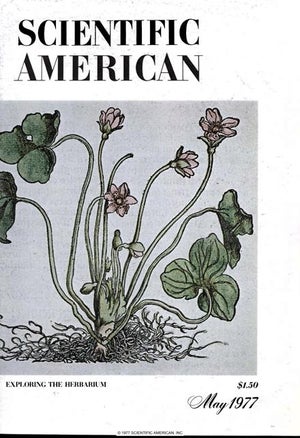
Valuable information on little-known plants that might provide new foods or drugs can be gathered by examining labels attached to the millions of specimens in the world's botanical collections
Norway rats survive in a hostile human environment by means of complex social mechanisms that ensure communal peace, equal opportunity between the sexes and early learning of vital information about the environment
The best guess about the future is usually obtained by computing the average of past events. Stein's paradox defines circumstances in which there are estimators better than the arithmetic average