Evolution
Introducing an issue devoted to the history of life on the earth a s it is understood in the light of the modern "synthetic" theory of evolution through natural selection, the organizing principle of biology today
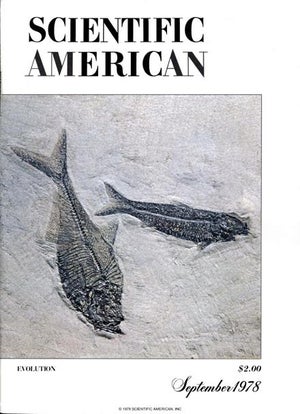
You are currently logged out. Please sign in to download the issue PDF.
Introducing an issue devoted to the history of life on the earth a s it is understood in the light of the modern "synthetic" theory of evolution through natural selection, the organizing principle of biology today
The rapid advances of molecular genetics over the past two decades have accounted for the origin of mutations and have revealed that the variation within species is much greater than Darwin postulated
Within one billion years after the formation of the earth 4.6 billion years ago one-celled organisms had evolved out of organic molecules produced nonbiologically in an atmosphere containing no free oxygen
For some three billion years the only living things were primitive microorganisms. These early cells gave rise to biochemical systems and the oxygen-enriched atmosphere on which modern life depends
It has been only during the last fifth of the history of life on the earth that multicellular organisms have existed. They appear to have arisen from unicellular organisms on numerous occasions
The coevolution of species within ecosystems gives rise to interesting patterns in the total number of species found in a given area, in their relative abundances and in the overall structure of the local food web
Here one of the key questions has to do with altruism: How is it that natural selection can favor patterns of behavior that apparently do not favor the survival of the individual?
A wealth of new fossil evidence indicates that manlike creatures had already branched off from the other primates by four million years ago. Homo sapiens himselfarose only some 100,000 years ago
The manifest fit between organisms and their environment is a major outcome of evolution. Yet natural selection does not lead inevitably to adaptation; indeed, it is sometimes hard to define an adaptation