The Brain
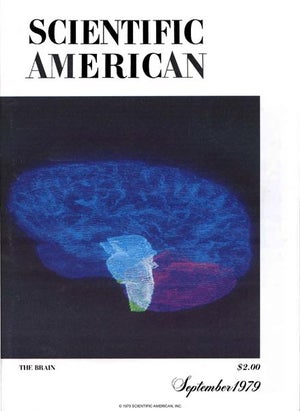
Introducing an lssue about neurobiology and its central problem: How does the human brain work? Although notable progress has been made, the question remains one of the profoundest confronting modern science
You are currently logged out. Please sign in to download the issue PDF.
Introducing an lssue about neurobiology and its central problem: How does the human brain work? Although notable progress has been made, the question remains one of the profoundest confronting modern science
It is the individual nerve cell, the building block of the brain. It transmits nerve impulses over a single long fiber (the axon) and receives them over numerous short fibers (the dendrites)
Such systems are the elementary units of mental function. Studies of simple animals such as the large snail Aplysia show that small systems of neurons are capable of forms of learning and memory
The brain and spinal cord of mammals, including man, consist of some billions of neurons, and a single neuron may connect with thousands of others. How is this enormous three-dimensional network organized?
As the human brain develops in utero it gains neurons at the rate of hundreds of thousands a minute. One problem of neurobiology is how the neurons find their place and make the right connections
Signals are sent from one neuron to another by diverse chemical transmitters. These chemical systems, overlaid on the neuronal circuits of the brain, add another dimension to brain function
A functional architecture that may underlie processing of sensory information in the cortex is revealed by studies of the activity and the organization in space of neurons in the primary visual cortex
How do the brain and the spinal cord bring about the movements of the body? They not only issue commands to muscles but also receive feedback signals that help to orchestrate the commands
Certain higher faculties, such as language, depend on specialized regions in the human brain. On a larger scale the two cerebral hemispheres are specialized for different kinds of mental activity
They can result from inherited metabolic defect, vascular disease, infection, tumor and trauma. The frontier in the study of mental illness is the relation between genetic and environmental factors
Reflecting on itself, the human brain has uncovered some marvelous facts. What appears to be needed for understanding how it works is new techniques for examining it and new ways of thinking about it