The Social Security System
The viability of the pay-as-you-go system is threatened by economic and demographic trends. The retired population and its benefits are growing faster than the active work force and its tax contributions
You are currently logged out. Please sign in to download the issue PDF.
The viability of the pay-as-you-go system is threatened by economic and demographic trends. The retired population and its benefits are growing faster than the active work force and its tax contributions
Many species of plants and animals, notably the dinosaurs, suddenly died out about 63 million years ago. A thin stratum of iridium-rich material suggests the cause may have been the fall of an asteroid
The gas combines explosively in familiar environments to form molecular hydrogen. A new technique that inhibits the reaction makes it possible to study certain properties of a quantum gas
The 17 icy bodies that orbit the planet display a surprising range of geological evolution. Many of them show craters more than four billion years old, but one of them has terrain so new that no craters are seen
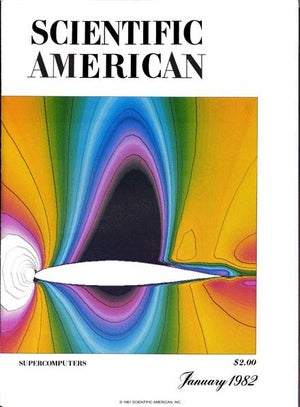
The Cray-1 and the CYBER 205 can perform 100 million arithmetic operations per second. This kind of "number crunching" is needed for the solution of complex problems such as those in fluid dynamics
Tracing the pedigree of nerve cells in the embryonic growth of dwarf and giant leeches yields preliminary clues to the functioning of the adult nervous system
A legacy of Alexander's conquest of Persia was a Greek kingdom in what is now Afghanistan. A French archaeological group has spent the past 15 years unearthing one of its cities, Ai Khanum
When people make risky choices, they often do not do so objectively. Experimental surveys indicate that such departures from objectivity tend to follow regular patterns that can be described mathematically