Scientific American Magazine Vol 246 Issue 5

Scientific American Magazine

Volume 246, Issue 5

You are currently logged out. Please sign in to download the issue PDF.

Features

Life Expectancy and Population Growth in the Third World

Explosive growth has been caused by a rapid decrease in the death rate since World War II. The decrease has slowed, but even if it resumed its former pace, the ultimate effect on population size would be small

Davidson R. Gwatkin, Sarah K. Brandel

Quarkonium

An "atom" made up of a heavy quark and an antiquark provides the best available system for examining the forces that bind together the elementary constituents of subnuclear particles

Elliott D. Bloom, Gary J. Feldman

NMR Imaging in Medicine

Nuclear magnetic resonance, or NMR, can reveal the distribution of atoms in a sample of material. It can do the same in the body, generating images of internal structure without the use of X rays

Ian L. Pykett

The Genetics of Antibody Diversity

Segments of DNA and RNA are shuffled and joined in various ways as cells of the immune system develop. The combinatorial process can generate information specifying billions of different antibodies

Philip Leder

The Asymmetry of Flounders

Flatfishes have both eyes on one side of the head, and in most Ratfish species the eyes are predominantly on the left side or the right. Is there some adaptive reason for this "handedness"?

David Policansky

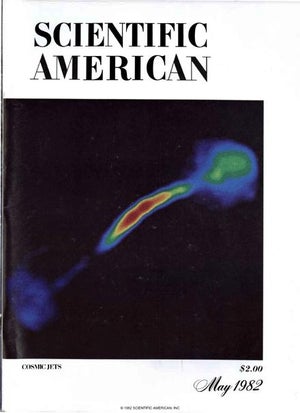
Cosmic Jets

The violent activity at the center of many galaxies is manifested in the production of narrow, focused streams of ionized gas. Some are a few light-years long; others are a million times longer

Martin J. Rees, Mitchell C. Begelman, Roger D. Blandford
The Gregorian Calendar

Pope Gregory XIII began the modern calendar 400 years ago in order to correct the accumulating drift in the Julian calendar and keep Easter in the spring

Gordon Moyer

The Regeneration of Potato Plants from Leaf-Cell Protoplasts

A new approach to the cloning, or asexual propagation, of plants starts with living cells that have been stripped of their outer wall. The method yields variants that promise future crop improvements

James F. Shepard

Departments

Letters to the Editors, May 1982

50 and 100 Years Ago: May 1982

The Authors, May 1982

Metamagical Themas, May 1982

Books, May 1982

Science and the Citizen, May 1982

The Amateur Scientist, May 1982

Bibliography, May 1982