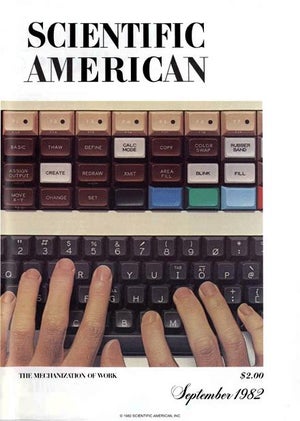
The Mechanization of Work
Introducing an issue on the continuing Industrial Revolution two centuries after it began. In the U.S. it has now displaced two-thirds of the labor force from the production of goods
You are currently logged out. Please sign in to download the issue PDF.
Introducing an issue on the continuing Industrial Revolution two centuries after it began. In the U.S. it has now displaced two-thirds of the labor force from the production of goods
In the U.S. at the beginning of the 19th century some 70 percent of the labor force worked on the farm. Today 3 percent not only feeds the population but also produces a large surplus for export
Today more than 80 percent of the mineral needs of the U.S. economy are met by only 1 percent of the labor force. Here the mechanization of mining is examined in terms of its effect on the mining of coal
Mechanization on the factory floor continues, but greater changes are being introduced by new technology for the design of products and for planning, managing and coordinating their manufacture
Such services as finance, transport, distribution communication are being mechanisede even more than the production goods.In the process they call for workers with ever high level of education
The office is the primary locus of information work, which is coming to dominate the U.S. economy. A shift from paperwork to electronics can improve productivity; service to customers and job satisfaction
When it began two centuries ago, it was characterized by low pay and occupational segregation. The same holds true today, although women are entering the labor force in larger numbers
When workers are displaced by machines, the economy can suffer from the loss of their purchasing power. Historically the problem has been eased by shortening the work week, a trend currently at a standstill